

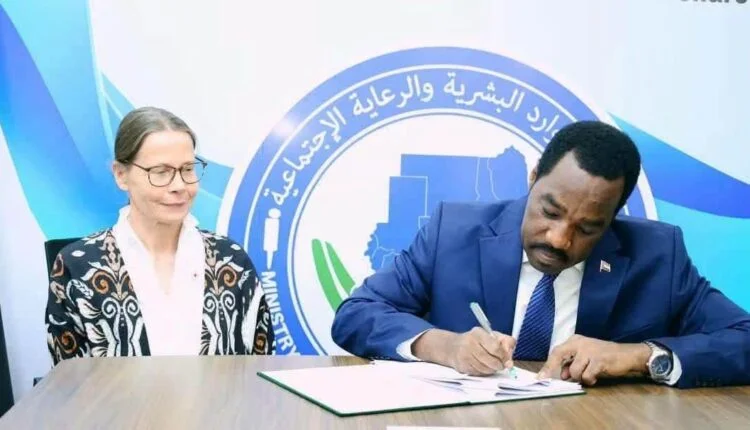
Sudan’s Ministry of Human Resources and Social Welfare has signed an agreement with the International Committee of the Red Cross to provide technical and financial support for physical rehabilitation and prosthetic and orthotic services across the country.
The agreement was signed by Sudanese Minister of Human Resources and Social Welfare Mutasim Ahmed Saleh and is intended to strengthen the capacity of rehabilitation centres serving people with disabilities, those wounded during the war and other people affected by the conflict.
According to reports from Sudan Horizon and The Citizen, the partnership encompasses clinical services, equipment, professional training and practical assistance intended to help patients reach and complete rehabilitation.
The agreement represents an important effort to sustain services at a time when Sudan’s conflict has increased the need for trauma care and physical rehabilitation while damaging healthcare infrastructure and disrupting supply chains.
Support extends across the rehabilitation pathway
The reported scope of the agreement extends beyond the supply of prosthetic components or finished devices.
Planned assistance includes:
- Materials and equipment for rehabilitation centres
- Prosthetic and orthotic devices
- Wheelchairs and other assistive products
- Physiotherapy services
- Maintenance of workshop and clinical equipment
- Operational support for participating centres
- Incentives for technical personnel
- Training, technical supervision and capacity building
- Transportation, accommodation and living expenses for beneficiaries
This broad approach reflects the realities of delivering physical rehabilitation during a humanitarian emergency. A centre may have qualified staff but be unable to operate because machinery requires maintenance, raw materials are unavailable or electricity and other essential services are unreliable.
Similarly, a patient may qualify for treatment but be unable to reach a rehabilitation centre or remain nearby for the multiple appointments required to manufacture, fit and align a prosthesis or orthosis.
By including transport, accommodation and subsistence support, the agreement recognises that access depends on more than the availability of a device.
Supporting both infrastructure and personnel
Staff incentives and capacity-building programmes are particularly significant for the long-term viability of Sudan’s rehabilitation sector.
Conflict can lead to the displacement or loss of experienced prosthetists, orthotists, technicians, physiotherapists and other rehabilitation professionals. Those who remain may be working under difficult conditions with limited equipment, interrupted salaries and growing caseloads.
Training and technical supervision can help maintain clinical and manufacturing standards, while operational support and staff incentives may assist centres in retaining their existing workforce.
Equipment maintenance is equally important. Prosthetic and orthotic workshops rely on ovens, vacuum systems, grinding and finishing machinery, alignment equipment, hand tools and specialist measurement systems. When equipment fails and replacement parts cannot be obtained, an entire stage of production may stop.
A sustainable programme therefore needs to consider personnel, equipment, consumables and patient access as interconnected parts of the same service.
Rehabilitation as part of recovery and reintegration
Minister Saleh described the agreement as a practical step towards strengthening rehabilitation and supporting the reintegration of people affected by the war.
Appropriate rehabilitation can help an injured person regain mobility, return to education or employment and participate more independently in family and community life. However, these outcomes require a complete care pathway that combines clinical assessment, device provision, therapy, training, follow-up and repair.
The ICRC’s work in Sudan already includes support for hospitals and health facilities, emergency assistance for displaced communities and cooperation with Sudanese authorities providing rehabilitation services for people with disabilities.
According to the ICRC, seven Sudanese hospitals received technical, material and financial support during 2025, facilitating approximately 155,000 emergency consultations and 27,000 surgical admissions. The scale of emergency and surgical care points towards a continuing need for post-operative rehabilitation, mobility devices and longer-term support.
Not every person requiring rehabilitation has a conflict-related injury. Sudan’s centres must also continue serving people with congenital limb differences, diabetes-related amputation, neurological conditions, musculoskeletal disorders and other causes of physical disability.
Implementation details will determine the impact
The publicly available reports do not specify the agreement’s financial value, duration, implementation timetable or the individual rehabilitation centres that will receive support.
These details will be important for assessing its eventual impact. Clear information on participating centres, workforce development, device production, waiting times, repairs and patient outcomes would help demonstrate whether the agreement translates into sustainable improvements.
Service statistics should also distinguish between devices delivered, patients treated and individual clinical or technical interventions. One patient may require numerous appointments and services during a single rehabilitation pathway.
Despite the unanswered implementation questions, the agreement’s comprehensive scope is encouraging. It recognises that restoring physical rehabilitation in a conflict-affected country requires more than importing prosthetic limbs. It requires functioning centres, trained and supported professionals, maintained equipment, reliable materials and practical assistance that enables patients to access care.
For Sudan’s O&P community and the people who depend on its services, the agreement offers a foundation on which more resilient national rehabilitation capacity can be rebuilt.
- Sudan Horizon: ICRC-Sudan Rehabilitation Agreement
- The Citizen: Sudan and ICRC Sign Rehabilitation Agreement
- International Committee of the Red Cross in Sudan
- ICRC: Sudan’s Humanitarian and Healthcare Needs
- WHO: Rehabilitation