

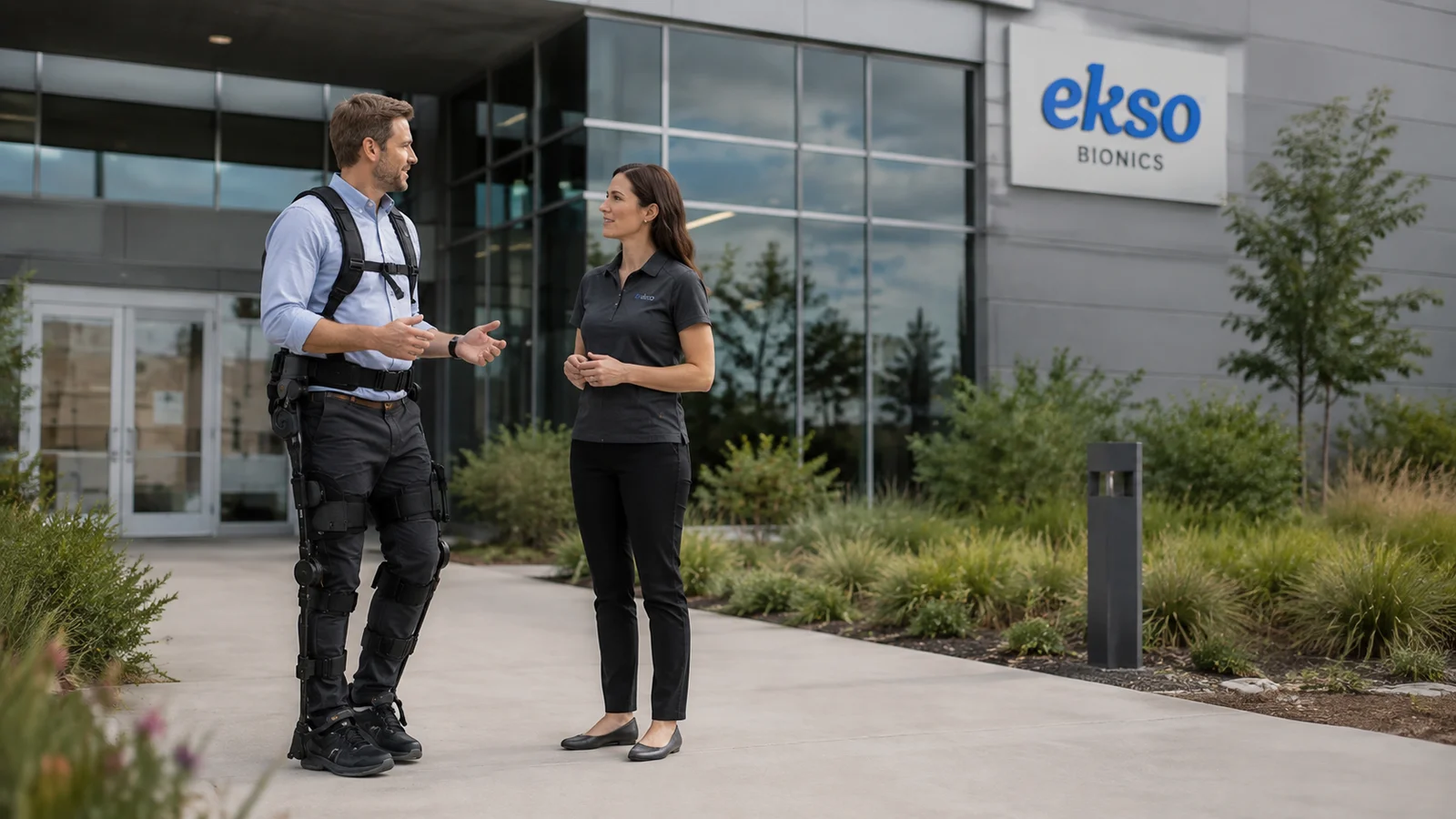
ChronoScale Corporation has formally classified its Ekso Bionics exoskeleton operation as “held for sale” and discontinued operations as the US-listed company shifts its attention towards cloud computing, amidst ongoing discussions about the Ekso Bionics sale.
The classification was disclosed in ChronoScale’s annual report for the year ending 31 May 2026 and examined in a report by the Exoskeleton Index.
ChronoScale intends to divest its wholly owned subsidiary, Ekso Bionics, Inc., but no buyer, transaction value or final sale structure has yet been announced. The development should therefore be understood as an active divestiture process—not a completed acquisition or an announcement that Ekso products have been discontinued.
The Ekso Bionics sale is expected to attract interest from various stakeholders in the industry.
For hospitals, neurorehabilitation centres, distributors and exoskeleton users across the Middle East, Africa, Central Asia and South Asia, attention will now turn to continuity of product support, training, servicing and regulatory responsibility during any ownership transition.
Sale plan follows ChronoScale transformation
Ekso Bionics entered 2026 as one of the best-known publicly traded companies dedicated to wearable robotics. That position changed following a business combination involving Applied Digital Cloud, completed in May, leading to this significant development regarding the Ekso Bionics sale.
The continuing public company became ChronoScale, incorporating a cloud-computing business alongside the legacy Ekso operation. ChronoScale subsequently decided to focus solely on cloud infrastructure and separate the exoskeleton subsidiary.
A regulatory filing dated 4 June 2026 states that the board committed to the divestiture plan on 29 May. It also warns that completing a sale is not guaranteed and refers to the possibility of either selling or winding down the business.
ChronoScale’s annual report, filed on 19 August, formalised the separation by reporting Ekso as a discontinued operation and its associated assets and liabilities as held for sale.
The company expects the divestiture to be completed during its 2027 fiscal year. However, this remains management’s anticipated timeline and may change according to negotiations and market conditions.
What does “held for sale” mean?
“Held for sale” is an accounting classification applied when management has committed to disposing of a business or group of assets and considers a sale sufficiently probable under the relevant accounting rules.
It does not mean that Ekso Bionics has already been sold, ceased trading or withdrawn its products.
ChronoScale reported approximately $19.84 million in assets associated with the legacy Ekso operation at 31 May 2026, compared with liabilities of around $5.03 million. These figures include intellectual property and other intangible assets, property and equipment, accounts receivable, leases and deferred revenue.
Its discontinued-operations statement recorded revenue of $385,000 and a net loss of $1.02 million. Importantly, these amounts cover only the short period between completion of the business combination on 5 May and the financial year end on 31 May. They should not be interpreted as Ekso Bionics’ normal full-year operating performance.
More than an exoskeleton hardware portfolio
Ekso Bionics has accumulated considerable experience in powered exoskeleton development, regulatory compliance, clinical implementation and therapist education.
Its current rehabilitation portfolio includes EksoNR, a robotic exoskeleton used by rehabilitation professionals for gait training, and Ekso Indego Personal, a modular powered lower-limb orthosis intended to support eligible people with spinal cord injuries in home and community settings.
The wider business also includes industrial technology such as the passive Ekso EVO upper-body exoskeleton.
A potential buyer may therefore be evaluating more than physical devices. The value of the operation could include:
- Patents and developed technology
- Medical-device registrations and regulatory experience
- Clinical evidence and research relationships
- Therapist-training programmes
- Hospital and rehabilitation-centre customers
- Distribution and servicing networks
- Reimbursement experience
- Software, usage data and digital platforms
- The established Ekso brand
ChronoScale has not disclosed whether it intends to sell the business intact or whether parts of the portfolio could be transferred separately.
Questions for IMEA rehabilitation providers
The immediate practical issue for existing customers is continuity.
Ekso systems require trained operators, clinical protocols, software support, spare parts and specialist technical servicing. A change in ownership may ultimately strengthen these capabilities if the buyer has greater financial resources, established medical-device distribution or a larger global service network.
However, a prolonged or fragmented transaction could create uncertainty. Hospitals and distributors considering new purchases should clarify:
- Which legal entity will remain responsible for warranties
- Whether existing maintenance and service agreements remain valid
- Availability of replacement parts and software updates
- Continuity of clinician and technical training
- Status of local distributors and representatives
- Ownership of patient and device-performance data
- Whether product registrations require amendment after a sale
- Long-term support for installed systems
These questions are particularly relevant across IMEA, where specialist technical support may already depend on regional distributors or engineers travelling between countries.
Local medical-device registrations may also name a particular manufacturer, authorised representative or importer. Any change to the legal manufacturer or product ownership could require regulatory notifications or amendments, depending on the jurisdiction and transaction structure.
A test for the wearable-robotics market
The planned divestiture reflects a wider evolution in wearable robotics. Specialist exoskeleton developers increasingly require significant capital for clinical research, regulation, manufacturing, distribution, reimbursement and continuing customer support.
Several companies have responded through partnerships with larger medical, industrial or automotive groups. Ottobock acquired SUITX, while Renault invested in Wandercraft and established an industrial partnership supporting exoskeleton manufacturing.
Ekso Bionics could attract interest from a medical-technology company, rehabilitation equipment group, robotics manufacturer, industrial safety business or investment organisation seeking an established position in wearable robotics.
The identity of the buyer will matter. Ownership by a company with strong healthcare infrastructure could accelerate international distribution and provide the investment required to expand clinical adoption. A financial or industrial buyer may take a different approach to the medical and personal-mobility divisions.
For now, Ekso Bionics remains an operating exoskeleton business. The confirmed development is that ChronoScale has separated it from its continuing cloud operations and intends to sell it. Until a transaction is announced, assumptions about the future owner, purchase price or product strategy remain speculative.
- Exoskeleton Index: Ekso Bionics Business Held for Sale by ChronoScale
- ChronoScale Form 8-K Announcing the Divestiture Plan
- ChronoScale Annual Reports and SEC Filings
- Ekso Bionics Official Website
- Ekso Indego Personal