

Wearable technology is moving beyond simply counting steps, recording heart rate or measuring how long somebody has been active.
The more important question is increasingly becoming: what can those measurements tell clinicians and researchers about a person’s health and function?
That shift is driving growing interest in digital biomarkers — objective, quantifiable measures generated from digital technologies that may provide insights into disease, physical function, behaviour and changes in health over time.
For prosthetists, orthotists and rehabilitation professionals, the development could eventually be significant. Instead of relying predominantly on observations made during appointments, clinicians could potentially gain a much clearer picture of how patients actually move and function throughout everyday life.
From wearable data to meaningful health information
A wearable sensor can generate enormous quantities of data.
Movement, acceleration, step frequency, temperature, heart rate and other physiological signals can potentially be recorded continuously.
But data itself is not necessarily clinically useful.
The challenge is identifying patterns within those measurements that correspond with meaningful changes in a person’s health or functional status.
This is the principle behind digital biomarkers.
Research published in npj Digital Medicine in 2025 reviewed the growing use of multidimensional digital biomarkers in Alzheimer’s disease, highlighting measurements relating to cognition, movement, behaviour and physiological function. The researchers argued that digital technologies could potentially complement established clinical assessments by providing continuous and objective information.
Similar research is taking place across a range of neurological conditions.
A 2024 review examining digital biomarkers in Parkinson’s disease highlighted growing research involving smartphones and wearable devices to measure changes in physiological and functional characteristics associated with the condition.
Measuring life outside the clinic
One of the most interesting aspects of digital biomarkers is that measurements can potentially be collected where patients actually live.
Traditional clinical assessments provide valuable information, but they inevitably represent a snapshot.
A patient may walk along a clinic corridor while being observed by a prosthetist or physiotherapist. An orthotic patient might perform several functional tasks during an appointment.
Those observations matter.
However, they cannot necessarily show what happens during the other hundreds of hours between appointments.
Does the patient continue wearing the device?
How far do they actually walk?
Does mobility deteriorate during the afternoon?
Is the person’s activity becoming gradually more restricted?
Does gait change before the patient notices a problem?
Wearables create the possibility of answering some of these questions objectively.
The 2023 Living Lab Study, led by researchers including Crook-Rumsey, was established specifically to investigate digital biomarkers of functional impairment in people living with neurodegenerative diseases. The study explored whether digital technology could provide objective measures of disease progression, changing care requirements and responses to interventions.
Milbotix takes sensing into the sock
One company exploring this field is UK wearable technology developer Milbotix.
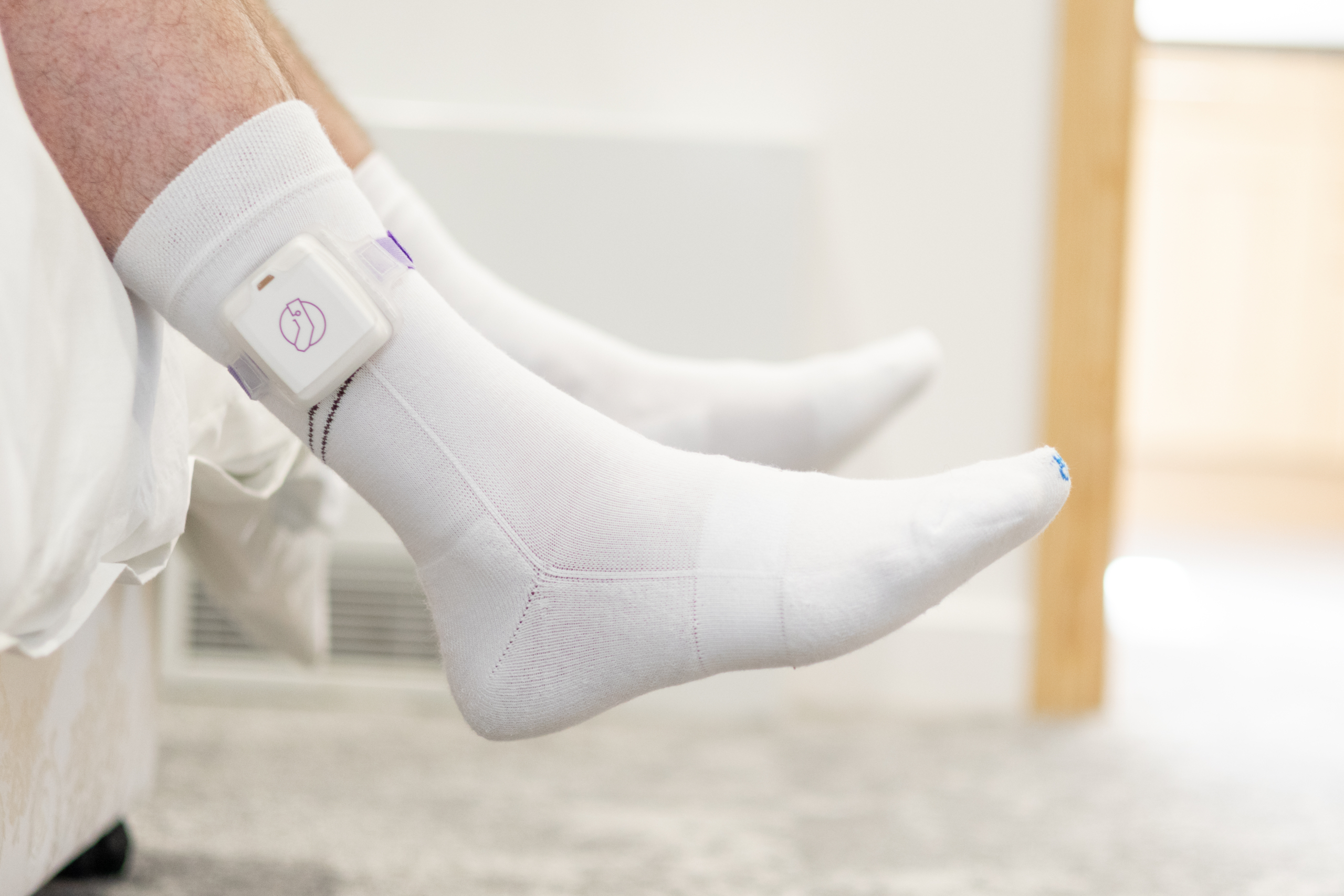
Its SmartSocks® platform places sensors within something most people already wear: a pair of socks.
According to Milbotix, SmartSocks incorporate e-textile and silicon sensors capable of measuring signals including pulse, temperature, sweat and movement. The company describes the approach as comfortable, familiar and non-stigmatising compared with some conventional wearable technologies.
That design philosophy is important.
A theoretically sophisticated wearable produces little useful longitudinal information if the person stops wearing it after several days.
Comfort, ease of use and acceptance therefore become fundamental components of successful digital health technology.
Milbotix is applying these principles to SmartSocks®DISCOVERY, a research-focused platform intended to support investigations involving movement and physiological sensing.
The company is already collaborating with academic researchers exploring digital biomarkers. One SmartSocks research project involves researchers from Northumbria University and Newcastle University with expertise in digital biomarkers and neurodegenerative disease research.
Why the location of the sensor matters
For the O&P profession, the concept of a sensor embedded within a sock is particularly interesting because of its proximity to the foot.
Where a sensor is positioned determines the type and quality of information it can collect.
The lower limb can provide valuable information about movement patterns, mobility and activity. Changes in walking behaviour can also be associated with neurological, musculoskeletal and functional decline.
Digital biomarkers derived from foot- or ankle-level sensing therefore potentially have applications extending well beyond conventional activity tracking.
Future systems could combine variables such as movement, cadence, activity patterns and physiological signals to identify changes that would be difficult to observe during an occasional clinic appointment.
This does not mean a wearable can replace clinical evaluation.
The more realistic opportunity is for digital biomarkers to add another layer of information to clinical decision-making.
A potentially important development for prosthetics
The concept is particularly relevant to prosthetic rehabilitation.
Prosthetists frequently face a fundamental information gap.
They can determine whether a prosthesis fits well in the clinic.
They can assess alignment.
They can observe gait.
They can ask the patient how frequently the prosthesis is being used.
But objectively understanding what happens once the patient leaves the clinic is considerably more difficult.
Digital monitoring could eventually provide information including:
- daily prosthetic use;
- walking volume;
- changes in cadence;
- activity intensity;
- periods of inactivity;
- changes in mobility over weeks or months;
- response to a new socket, foot or alignment adjustment.
For research, such measurements could also provide more objective comparisons between prosthetic interventions.
Rather than relying exclusively on questionnaires and laboratory-based gait measurements, researchers could potentially examine whether a technology genuinely changes how people function during normal daily life.
Orthotics could benefit too
The opportunity may be equally important in orthotics.
Consider a patient prescribed an AFO following stroke.
A clinician may assess gait before and after fitting and observe an immediate improvement.
But several unanswered questions remain.
Is the patient actually wearing the AFO at home?
Does it increase overall walking activity?
Does mobility gradually improve?
Does the patient’s gait become less stable when fatigued?
Could changes in movement suggest that the orthosis requires adjustment?
Continuous or repeated real-world data could help answer questions that conventional follow-up appointments struggle to capture.
Moving from activity monitoring to clinical intelligence
Wearable monitoring itself is not new.
Prosthetic activity monitors, smart insoles, pressure sensors and gait-analysis systems have existed for years.
What is changing is the sophistication with which that information can potentially be interpreted.
Modern sensor technology combined with machine learning and longitudinal datasets means researchers can increasingly look for combinations of signals rather than individual measurements.
A reduction in daily steps alone might mean very little.
But a simultaneous change in walking speed, movement variability, physiological signals and daily routine could potentially reveal something more meaningful.
That is the difference between recording activity and developing a digital biomarker.
Recent research continues to explore this direction. A 2026 study published in npj Digital Medicine, for example, investigated whether consumer wearable and mobile technologies could passively predict cognitive and mental-health outcomes under real-world conditions.
High-quality data remains essential
The potential is considerable, but digital biomarkers are only as useful as the data behind them.
Wearables must generate reliable signals.
Patients must use them consistently.
Algorithms must be validated against meaningful clinical outcomes.
Different populations must be represented in research.
Researchers also need to demonstrate that a statistically detectable signal actually represents something useful to clinicians and patients.
These considerations are particularly important before digital biomarkers begin influencing treatment decisions.
The future is therefore unlikely to be simply about creating more sensors.
It will be about identifying which measurements genuinely matter.
An opportunity for the O&P profession
For prosthetists and orthotists, digital biomarkers represent another indication that rehabilitation is becoming increasingly data-driven.
O&P has traditionally been a profession where experienced clinicians combine physical assessment, biomechanics, patient feedback and observation to make highly individualised decisions.
That expertise will remain essential.
But the profession now has an opportunity to supplement those skills with objective information collected between appointments.
The result could eventually be a very different model of follow-up.
Instead of asking a patient six months later, “How have you been getting on?”, clinicians may also be able to see how mobility has changed throughout those six months.
For researchers, the opportunity is potentially even greater.
Digital biomarkers could help demonstrate whether prosthetic and orthotic interventions translate into meaningful improvements outside laboratories and clinics — where patients actually live their lives.
That is the real promise of the next generation of wearable technology.
Not simply collecting more data.
Turning everyday movement into information that helps us understand function.
- Milbotix
- Milbotix – SmartSocks research collaboration
- Qi et al. – Alzheimer’s disease digital biomarkers
- Crook-Rumsey et al. – Living Lab Study
- International Society for Prosthetics and Orthotics
- IMEA CPO