

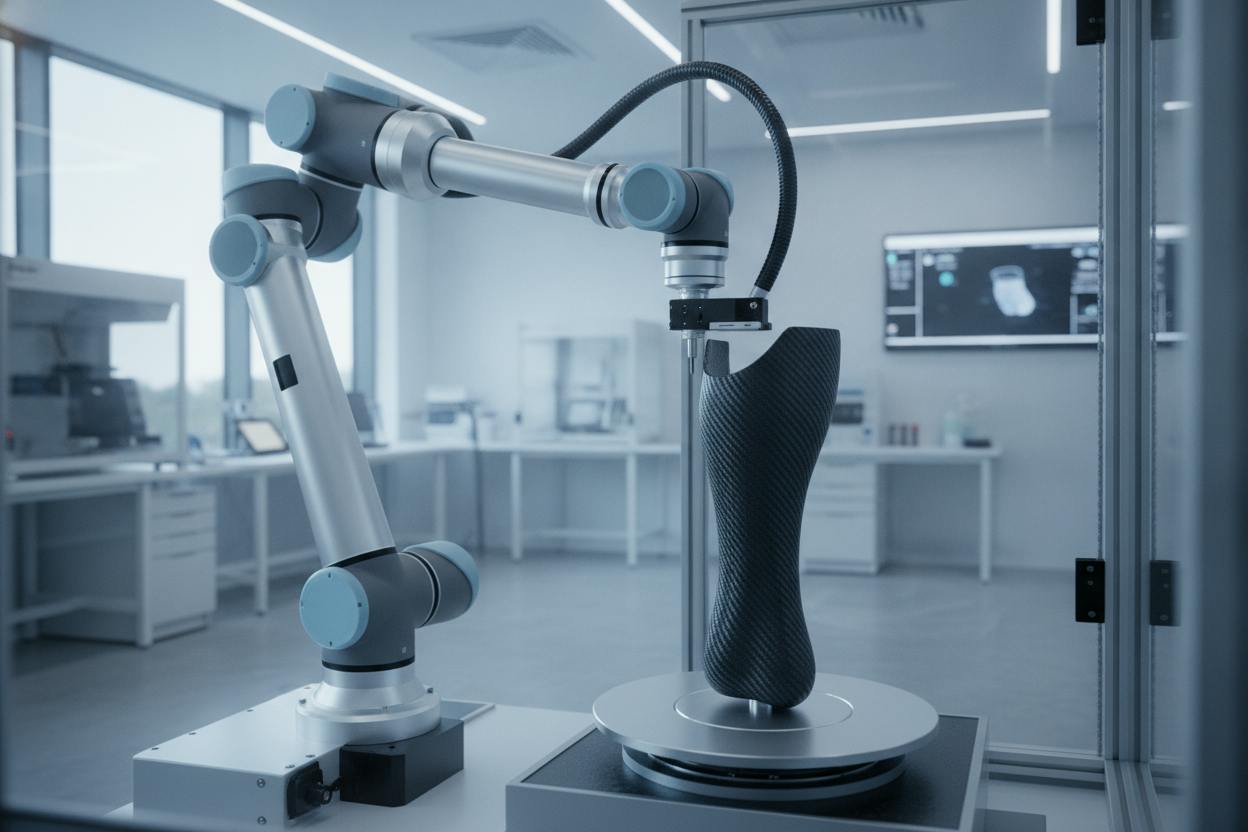
Vienna-based deep-technology startup Turn-Motion has raised pre-seed funding to develop an automated platform for manufacturing patient-specific orthotic, prosthetic and exoskeleton components from continuous carbon fibre.
Noctua Science Ventures led the equity portion of the round. Vienna technology company Squer and angel investors Florian Schwendinger, Benjamin Schwendinger and Sébastien Stassin also participated.
The official investment amount has not been disclosed. Austrian publication Brutkasten reported an estimated total of between €500,000 and €700,000 after speaking with Turn-Motion CEO Georg Popp. Although Dealroom described the transaction as a seed round, both Turn-Motion and lead investor Noctua position it as pre-seed financing.
The capital will be used to move the company’s manufacturing system towards pilot production and commercial readiness.
From 3D scanning to continuous-fibre production
Turn-Motion is developing an integrated system combining multi-axis robotic fibre placement, biomechanical simulation, artificial intelligence and automated production planning.
The company calls its manufacturing method “5D printing.” The term refers to a process in which both the print heads and build platform can move across multiple axes, allowing continuous fibres to be placed along complex, load-optimised paths.
This differs from conventional three-axis additive manufacturing, where material is normally deposited in flat layers. Layer-by-layer production may be effective for many applications, but it can be less suited to structures that must manage substantial, multidirectional loads while remaining thin and lightweight.
Turn-Motion says its process places thermoplastic, pre-impregnated continuous carbon fibres directly onto a supporting structure. It can reportedly process multiple preheated materials during production.
Its TURN-FPEO optimisation engine is intended to simulate loading across the gait cycle and calculate fibre orientation, material distribution and structural behaviour for the individual patient.
The proposed digital workflow includes:
- Capturing the patient’s anatomical and biomechanical data
- Processing information such as joint angles, gait characteristics and mobility requirements
- Generating a patient-specific design and fibre-placement strategy
- Simulating the expected mechanical response
- Producing the component through automated multi-axis fibre placement
- Completing and dispatching the customised device
The company says the platform will remain compatible with established mechanical orthotic-joint systems, allowing manufactured structures to be incorporated into familiar clinical configurations.
Addressing limitations of conventional lamination
Carbon-fibre orthoses are traditionally manufactured through a skilled, multistage process. This may involve model preparation, reinforcement planning, resin handling, vacuum processing, curing, trimming, finishing and assembly.
The process can produce strong and lightweight devices, but results depend heavily on the technician’s experience and the consistency of each manufacturing stage. It can also require substantial workshop time, ventilation, extraction, personal protective equipment and management of resin and composite waste.
Polymer additive manufacturing has automated parts of the workflow, but load-bearing orthoses may require increased wall thickness, local reinforcement or a relatively rigid design to achieve the necessary mechanical performance.
Continuous-fibre manufacturing could offer a different balance. Instead of relying primarily on the printed shape and wall thickness, the structure can theoretically be reinforced according to expected load paths.
Turn-Motion aims to combine the performance of carbon-fibre composites with the repeatability and customisation of digital manufacturing.
However, its claims regarding speed, strength, weight and cost are currently company and investor projections. Independent mechanical testing and clinical evidence will be required before direct comparisons can be made with laminated carbon devices or established polymer-printing methods.
Company targets production within hours
Turn-Motion says components that currently require days or weeks of manual production could eventually be produced within hours.
Its website promotes production and shipment within 24 hours and suggests that technicians could manage substantially more patients without increasing workshop workload. These remain commercial targets rather than independently verified clinical outcomes.
According to Brutkasten, the company plans to begin working with pilot customers in early 2027, target market readiness during the second half of 2027 and pursue a formal commercial launch in 2028.
Noctua reports that Turn-Motion has already demonstrated working fibre-placement hardware and presented a prototype at OTWorld 2026 in Leipzig. The company has reportedly grown to a 13-person team covering machine learning, simulation, CNC engineering and design.
Turn-Motion has also received more than €1 million in non-dilutive support from Austrian public funding organisations. Noctua says an initial pilot with Embla Medical is planned and that discussions have also taken place with other established O&P companies.
Founders combine personal, clinical and engineering experience
Turn-Motion was founded by Georg Popp, Chien-hua Huang and Manuel Lachmayr.
Popp is an architect specialising in adaptive structural design and has lived with paralysis resulting from poliomyelitis since infancy. His experience as an orthosis user influenced the company’s focus on reducing weight and restriction while improving movement.
Huang leads the development of the company’s AI-supported structural optimisation and simulation technology.
Lachmayr is a CPO who previously worked on scaling industrial 3D-printing systems. His involvement gives the founding team a connection to clinical orthotic practice as well as manufacturing automation.
This combination is important because successful digital O&P production requires more than material science and software. The system must also reflect clinical prescription, biomechanics, patient safety, fitting and the realities of workshop practice.
The CPO must remain responsible for prescription
Automating structural design does not remove the need for a qualified prosthetist-orthotist.
The clinician must still determine:
- The patient’s diagnosis and functional objectives
- Joint range of motion and muscle strength
- Sensation and skin condition
- Deformity flexibility
- Required alignment and corrective forces
- Joint selection and control strategy
- Areas requiring relief or accommodation
- Donning, footwear and cosmetic considerations
- Risks associated with falls, pressure and structural failure
An algorithm can analyse data and propose a fibre pattern, but the quality of the result depends on the completeness of the clinical input and the validity of the biomechanical model.
The final device will also require fitting, alignment, functional assessment and appropriate follow-up. Automated production should reduce repetitive workshop labour while allowing clinicians to spend more time on assessment, training and patient care—not transfer clinical responsibility to the software.
Evidence and certification remain ahead
Turn-Motion is still a pre-market company. Noctua acknowledges that major tasks remain, including industrialising the manufacturing process, obtaining the required medical-device certification and converting discussions with manufacturers into commercial agreements.
Before routine clinical use, the technology will need evidence covering:
- Structural strength and fatigue life
- Repeatability between manufactured parts
- Environmental and temperature resistance
- Joint and fastener integration
- Material traceability
- Failure modes and inspection requirements
- Cleaning, repair and recycling
- Clinical comfort and function
- Comparison with conventional fabrication
- Software validation and change control
- Cybersecurity and patient-data protection
Evidence will also be needed for each intended device category. A lower-limb orthosis, prosthetic socket and exoskeleton structure do not present identical loads, risks or regulatory requirements.
Potential relevance across IMEA
The platform could eventually be relevant to O&P services across India, the Middle East and Africa, where qualified professionals and advanced composite workshops are unevenly distributed.
A central production model could allow local CPOs to assess patients and approve designs while specialised facilities manufacture customised carbon-fibre structures. This may help clinics access advanced fabrication without investing in complete composite workshops.
The technology could be particularly valuable where clinicians serve large geographic areas or where conventional fabrication creates lengthy turnaround times.
However, its IMEA relevance will depend on practical questions:
- Final component and service costs
- Scanner and software requirements
- Internet connectivity
- Cross-border patient-data rules
- Shipping times and customs procedures
- Availability of local fitting and repair
- Performance in hot, dusty and humid environments
- Training for CPOs
- Regulatory registration in each market
- Whether devices can be modified locally
Turn-Motion’s funding reflects growing investment interest in automating customised O&P manufacturing. Its proposed combination of continuous carbon fibre, simulation and multi-axis production is technically ambitious.
The next test will be whether the company can translate a working manufacturing concept into certified devices that deliver reproducible mechanical performance, clinically meaningful benefits and an economically viable service for CPOs and their patients.
- Dealroom: Turn-Motion Funding Announcement
- Turn-Motion Official Website
- Noctua Science Ventures: Why We Invested in Turn-Motion
- Brutkasten: Turn-Motion Investment Report
- OTWorld: Turn-Motion Exhibitor Profile