

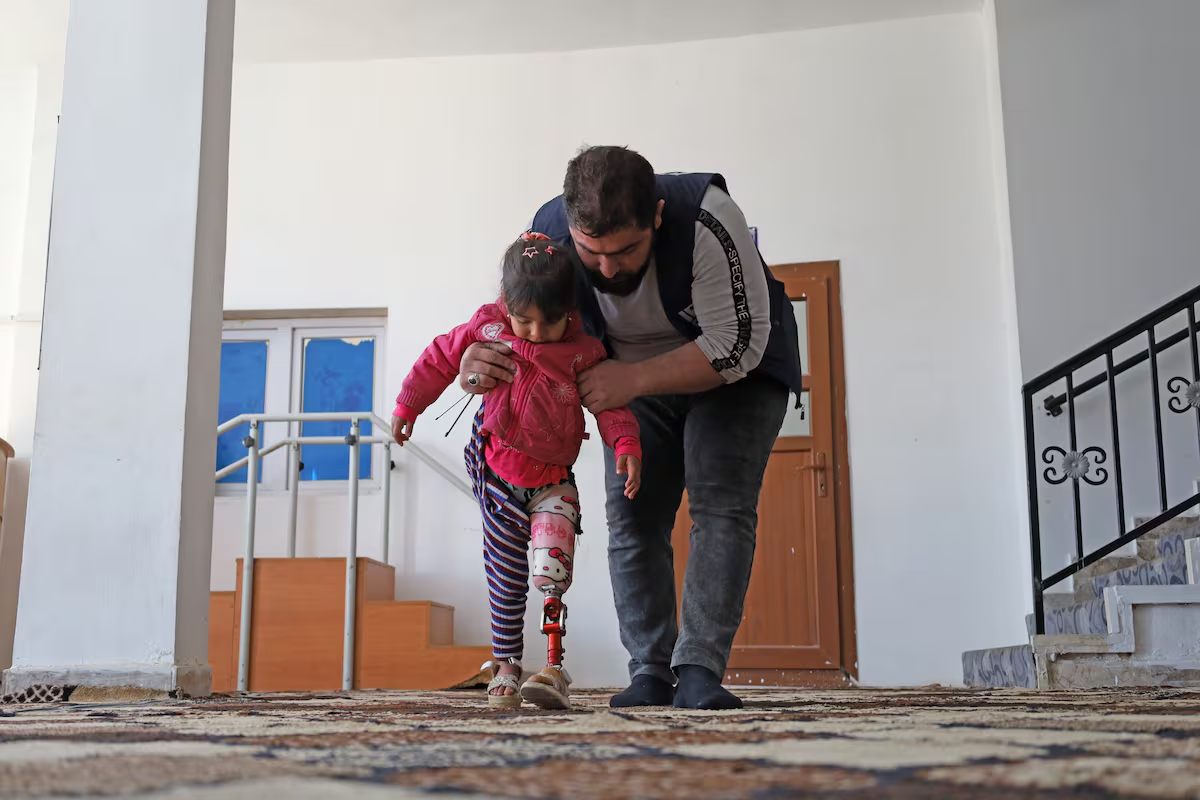
Rehabilitation centres in northwestern Syria are using digital scanning and 3D printing to produce lower-cost prosthetic limbs more quickly for people affected by conflict, landmines and unexploded ordnance.
The emerging production model was highlighted in a report by EL PAÍS, which followed patients and prosthetic professionals working with digital technology in Idlib province.
Among them was seven-year-old Salwa al Raslan, who lost a leg in a landmine explosion in early 2025. When her previous prosthesis broke, her family faced the prospect of a lengthy wait and a replacement cost they could not easily afford.
A centre using 3D printing was able to provide another prosthesis within a much shorter period, enabling Salwa to resume walking, playing and attending school.
Her experience demonstrates the potential value of locally maintainable digital manufacturing in a country where the demand for rehabilitation remains far greater than the available clinical and technical capacity.
An estimated 86,000 amputees
EL PAÍS reports that approximately three million Syrians have been injured since the conflict began in 2011, with almost half living with permanent disabilities. The number of people with amputations is estimated at around 86,000.
The burden continues to grow because unexploded ordnance remains scattered across the country. In January 2025, UNICEF reported that landmines and unexploded weapons had become the leading cause of child casualties in Syria.
UNICEF estimated that around five million children were living in areas contaminated by these hazards. Survivors may require surgery, prosthetic care, physiotherapy, psychosocial support and repeated follow-up over many years.
Syria’s existing prosthetic services include public facilities, private workshops and centres operated by humanitarian organisations. However, the country faces shortages of qualified prosthetists and orthotists, fabrication materials, specialist equipment and sustainable funding.
From scanning to 3D printing
According to the report, two Syrian centres now depend entirely on digital manufacturing and collectively serve between 100 and 150 patients per month, although monthly activity varies. Four additional centres are introducing the technology while continuing to use some conventional methods.
The digital workflow begins with scanning and the creation of a computer model. Technicians can then modify the design, retain the patient’s digital records and print the required structure layer by layer.
Storing the design digitally can make subsequent replacements or modifications easier. This can be particularly valuable for children, whose prostheses require regular review and replacement as they grow.
Digital records may also reduce the need to repeat every fabrication stage following device damage, provided the patient’s residual limb and clinical requirements have not changed.
The centres use comparatively low-cost printers imported from China. Their selection is based partly on the availability of replacement components and the ability of local teams to carry out repairs rather than relying entirely on overseas servicing.
Electricity is supplied through a combination of Syria’s national grid and solar panels. This hybrid arrangement reflects an important reality for digital O&P programmes in fragile settings: advanced manufacturing cannot be separated from reliable power, equipment maintenance and access to consumable materials.
Reported reduction in cost
Salwa’s father told EL PAÍS that her 3D-printed prosthesis cost approximately $100, compared with around $500 for the articulated prostheses the family had previously purchased.
That comparison reflects one family’s experience and should not be interpreted as a universal price for printed or conventionally manufactured prostheses. Costs vary according to the amputation level, socket design, materials, components, clinical input, rehabilitation and follow-up required.
The Idlib centres nevertheless report that digital manufacturing has shortened production times and reduced some fabrication costs. One clinician said a customised device could be produced in approximately one day, compared with the weeks sometimes associated with conventional local workflows.
Faster production may be especially important when a child cannot attend school or when an adult cannot work while waiting for a replacement device.
Technology must remain clinically led
3D printing does not remove the need for trained prosthetists, careful assessment or appropriate rehabilitation.
A successful prosthesis must do more than match a digital shape. Clinicians must assess residual-limb condition, volume fluctuation, pressure tolerance, suspension, alignment, component selection, gait and the patient’s functional environment.
Printed structures must also be evaluated for strength, repeatability and durability. The performance of a lattice or lightweight design will depend on material quality, printer calibration, print orientation, wall thickness and post-processing.
For centres working with children, additional safeguards are required because rapid growth can change socket fit and alignment. A stored digital file should therefore support reassessment rather than become a reason to reproduce an outdated socket without examining the patient again.
The teams interviewed also identified continuing constraints involving raw-material availability, equipment, technical expertise and workforce training. These factors will determine whether digital production can be scaled safely beyond a small number of specialist centres.
Building sustainable Syrian rehabilitation capacity
The development of local digital laboratories complements wider efforts to strengthen rehabilitation services inside Syria.
The International Committee of the Red Cross supports physical rehabilitation through centres and hospital units in Aleppo, Homs, Qamishli, Hasakeh and other locations, working with Syrian health authorities and the Syrian Arab Red Crescent.
Since the beginning of 2025, the ICRC says it has supported more than 3,100 people with physical rehabilitation, delivered nearly 8,900 physiotherapy sessions and provided capacity-building assistance to 122 rehabilitation professionals and technical instructors.
Digital technology can contribute to this broader system when it is accompanied by clinical governance, professional education, quality control and dependable local maintenance.
Syria’s experience is relevant to other conflict-affected and resource-constrained settings across the IMEA region. The central lesson is not simply that a prosthesis can be printed. It is that carefully selected digital tools can help local professionals build a more responsive production system around the patient.
- EL PAÍS: 3D Printing Returns Hope to Amputees in Syria
- ICRC: Physical Rehabilitation and Recovery Across Syria
- UNICEF: Children at Risk from Unexploded Ordnance in Syria
- UNICEF Syria Annual Report 2025
- World Health Organization: Rehabilitation