

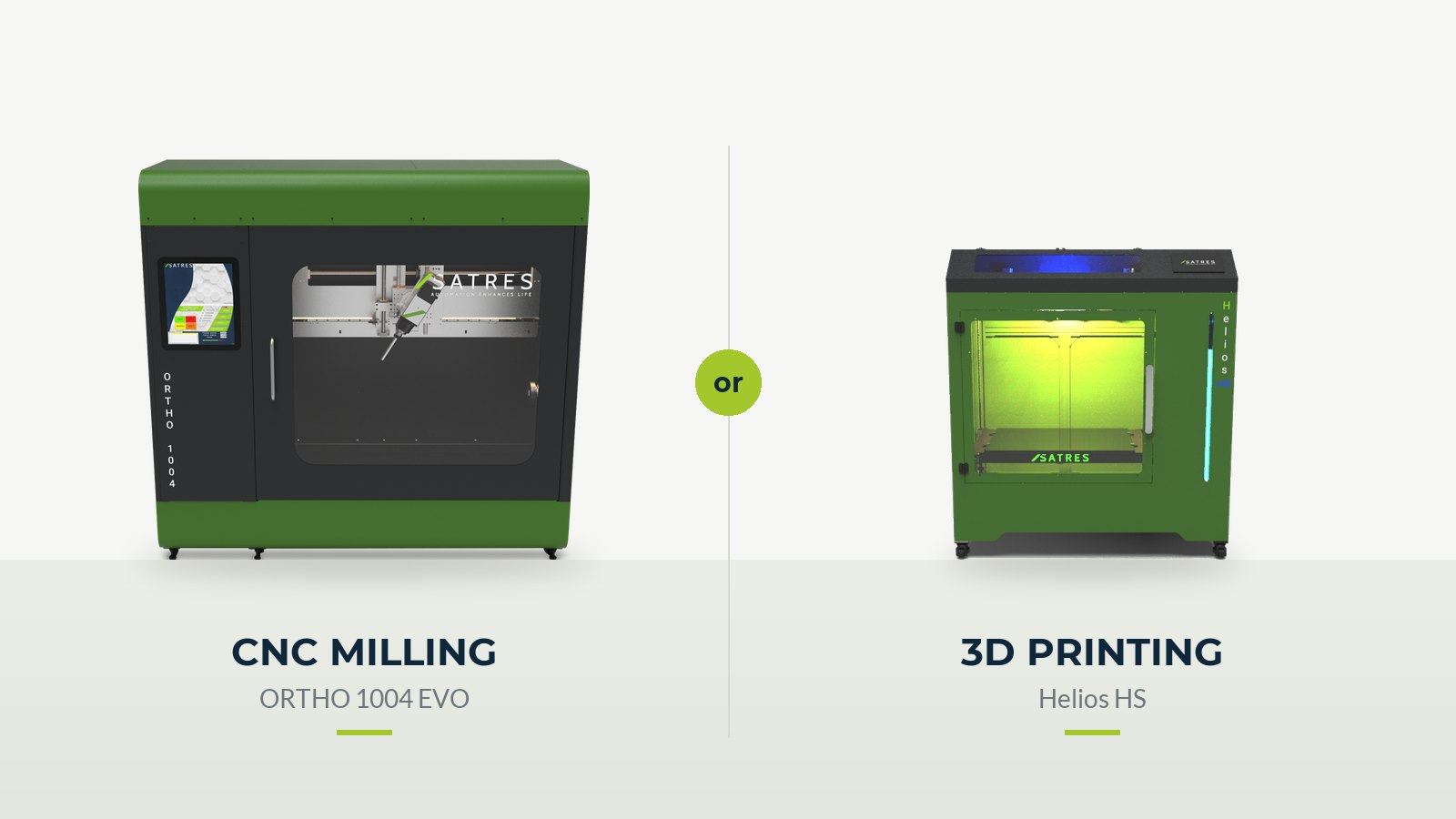
Should an orthopaedic workshop invest in a CNC milling machine or a 3D printer?
SATRES, an Italian manufacturer of both technologies, says the answer should begin with what the workshop produces—not with the specifications of the machine.
The company has published a new guide intended to help prosthetic and orthotic facilities evaluate their clinical workload, production model, infrastructure and long-term operating costs before committing to either technology.
It addresses an increasingly important decision for O&P providers across India, the Middle East and Africa as workshops seek to reduce their reliance on plaster while improving repeatability, turnaround time and digital traceability.
The central message is that neither technology is universally superior. Milling and additive manufacturing solve different production problems, and some facilities may ultimately benefit from combining them.
Begin with the workshop’s caseload
Before comparing equipment, a workshop should document what it currently manufactures, what it outsources and which cases it cannot presently accept.
This assessment should include the monthly volume of:
- Prosthetic sockets
- AFO and KAFO positive models
- Spinal brace models
- Custom seating shapes
- Foot orthotic models
- Shoe lasts
- Directly manufactured orthoses
The workshop must then decide whether it wants to digitise its established fabrication process or replace parts of that process entirely.
CNC milling generally converts a digital patient model into a physical positive made from polyurethane or another machinable material. The technician can then thermoform or laminate over that model using familiar workshop techniques.
Direct 3D printing removes the positive model from selected workflows by manufacturing the device itself from a digital design. This can reduce intermediate stages, but it introduces different requirements relating to material selection, print orientation, validation, post-processing and quality control.
When CNC milling makes sense
Milling can be an accessible transition for workshops that want to move away from plaster without abandoning established thermoforming and lamination methods.
The patient can be scanned, the digital model rectified in CAD software and the positive shape milled. The remaining fabrication process will therefore remain familiar to many technicians.
According to SATRES, a three-axis system may be sufficient for comparatively straightforward applications such as spinal models, cosmetic shapes and foot-orthotic production. A fourth axis becomes important when the workshop needs to produce more complex shapes around the full circumference of a model, including AFO and KAFO forms, shoe lasts and seating applications.
SATRES offers both three- and four-axis systems. Its ORTHO 1004 EVO is promoted as a compact four-axis platform for applications including prosthetic models, AFOs, KAFOs, insoles, corsets, shoe lasts and seating shapes.
However, milling still requires blocks, cutters, extraction, waste management and suitable workshop space. Buyers must consider dust containment, tool replacement and the recurring cost of model material—not only production speed.
When direct 3D printing may be preferable
Direct printing may be attractive where a workshop wants to manufacture finished orthoses or prosthetic devices without first producing a positive model.
Potential advantages include:
- Reduced use of physical model material
- Production of complex geometries
- Digital repeatability
- Easier storage of patient files
- Opportunities for distributed manufacturing
- Less dependence on plaster rooms and physical mould storage
SATRES describes its Helios HS as a high-speed printer developed for orthopaedic production.
Nevertheless, buying a printer does not automatically establish a clinically reliable workflow. The facility must understand how the chosen material behaves under load, heat, moisture and repeated use. It must also control print orientation, wall thickness, finishing, inspection and device traceability.
Workshops should request evidence for the particular device and material combination they intend to manufacture rather than assuming that every printable polymer is suitable for every clinical application.
Infrastructure matters across IMEA
Infrastructure can change the investment decision significantly.
A milling machine may require three-phase electricity, extraction equipment, compressed air and adequate access for installation. A printer may require controlled material storage, ventilation, stable environmental conditions and dependable post-processing equipment.
These issues are particularly important where workshops face voltage fluctuations, high temperatures, humidity, limited local technical support or difficulty importing replacement parts.
The strongest machine on paper may become the weakest commercial option if a minor fault stops production for several weeks.
Workshops should therefore establish who provides installation, operator training, remote diagnostics, software support, replacement parts and on-site repairs within their country.
Compare three-year cost—not purchase price
SATRES recommends comparing the complete cost of ownership rather than focusing only on the quoted equipment price.
The calculation should include:
- Machine and software costs
- Shipping, customs and installation
- Scanning and CAD equipment
- Extraction or post-processing systems
- Raw materials and consumables
- Operator time
- Training and workflow development
- Maintenance contracts and replacement parts
- Failed jobs and remakes
- Electricity and environmental control
- Financing costs
- Expected downtime
The company has also introduced an online ROI calculator to help workshops compare investment and operating assumptions using their own production figures.
Calculations should use realistic volumes. A machine capable of high output will not necessarily provide a good return if the workshop lacks sufficient caseload, trained staff or demand for the devices it produces.
Questions every supplier should answer
Before purchasing, an O&P provider should ask:
- Which of our actual devices can the system manufacture?
- Can we inspect comparable devices produced by another workshop?
- Which materials and software are required?
- Is the workflow open or tied to proprietary consumables?
- What additional infrastructure must we install?
- What training is included?
- How long will staff need to become productive?
- How is clinical and manufacturing traceability maintained?
- What happens if the machine fails?
- Are technicians and spare parts available locally?
- What is the realistic cost per completed device?
- What is the total cost during the first three years?
The value of the SATRES guide lies in moving the conversation away from whether milling or printing is “better.” The real question is which process fits the workshop’s devices, clinicians, technicians, infrastructure and sustainable production volume.
For many IMEA facilities, the right digital transition may be CNC milling, direct 3D printing, outsourced digital manufacturing or a phased combination of all three.
- SATRES: CNC Milling Machines and 3D Printers for Orthopaedic Workshops
- SATRES Guide to Choosing Between CNC Milling and 3D Printing
- SATRES Orthopaedic Solutions
- SATRES ORTHO 1004 EVO Milling System
- SATRES Helios HS Orthopaedic 3D Printer
- SATRES ROI Calculator