

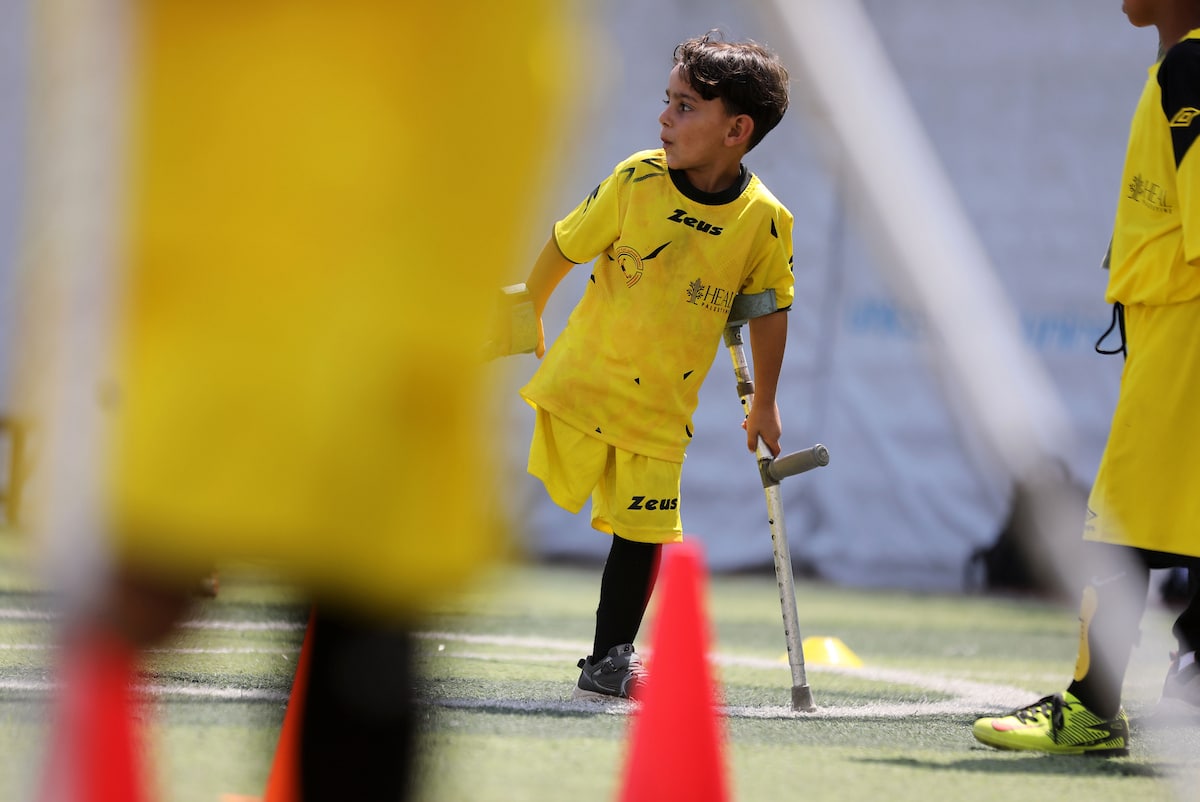
For a child with limb loss, receiving a prosthesis is not the end of treatment. Growth continually changes the relationship between the residual limb, socket, prosthetic components and the rest of the body.
In a functioning paediatric prosthetic service, these changes are managed through regular reviews, socket adjustments, component replacement, physiotherapy and, in some cases, further surgery.
For children in Gaza, restricted supplies, damaged services and limited access to medical evacuation are disrupting this essential cycle of care.
A report published by Mondoweiss describes children continuing to use painful or poorly fitting prostheses because replacements are unavailable, while others remain without their first device.
When the child grows but the prosthesis does not
The report follows 11-year-old Abdul-Rahman al-Nashash, whose existing lower-limb prosthesis has become painful as his body and residual limb have changed.
According to his family, clinicians advised him to stop wearing the device. He reportedly continues to use it because he wants to walk and does not want others to notice his disability.
His case illustrates the pressure a child may place upon themselves to remain mobile, attend school, participate socially and resemble their peers—even when a device no longer fits safely.
A socket that has become too tight can cause:
- Localised pressure and pain
- Skin irritation and breakdown
- Reduced wearing time
- Changes in gait
- Compensatory movement
- Increased risk of falling
- Reluctance to use the prosthesis
- Interruption of rehabilitation
Children require continuing review because height, weight, limb length, activity and functional goals can all change rapidly. Research into paediatric prosthetic provision identifies socket-fit problems and differences in prosthetic length as significant consequences of physical growth.
Osseous overgrowth creates an additional risk
Growth-related socket problems should be distinguished from terminal osseous overgrowth, a recognised complication in some children with acquired amputations.
This occurs when bone grows at the end of the residual limb, sometimes forming a painful prominence that places pressure on the surrounding tissue and socket. It can lead to skin damage, difficulty wearing a prosthesis and the need for revision surgery.
The Mondoweiss report cites a Gaza rehabilitation specialist who explains that not every child requires annual revision surgery, but bone overgrowth can create severe problems in some cases.
Published paediatric research similarly describes terminal osseous overgrowth as a complication that can cause pain, pressure ulcers and prosthetic-fitting difficulties, making close follow-up essential.
This is not a problem that can be solved simply by supplying a larger socket. The child may require specialist surgical assessment, wound care and a period of rehabilitation before a new prosthesis can be fitted.
Some children are still waiting for a first prosthesis
The report also profiles 10-year-old Mahmoud al-Darbali, who sustained a very high-level lower-limb amputation and had reportedly been waiting for more than a year for his first prosthesis.
Clinicians cited in the article said that devices for such complex amputation levels had previously been provided within Gaza, but the necessary materials were no longer available.
Extended periods without appropriate mobility and rehabilitation can contribute to weakness, contractures, reduced movement and increasing dependence upon crutches or wheelchairs. The damaged environment also places greater strain on mobility devices, which require frequent maintenance and replacement.
For children, delay can affect much more than walking. It can limit education, play, social development, confidence and participation in family life.
WHO figures show the scale of the gap
A World Health Organization technical update published in May 2026 estimated that more than 5,000 limb amputations had occurred in Gaza since October 2023 and that approximately one in five amputees was a child.
Among 2,277 amputees evaluated between September 2024 and May 2026:
- 502 had received a prosthesis
- 18% were children
- 76% had lower-limb amputations
- 32% had above-knee amputations
- 225 required residual-limb revision surgery
- Eight prosthetists were working in Gaza
WHO also reported that no rehabilitation equipment entered Gaza between May 2024 and 14 April 2026. At the reporting date, 18 assistive-product shipments were pending, with an average wait of 136 days and a maximum recorded delay of 526 days.
The pending items included prosthetic limbs, adult and paediatric wheelchairs and equipment needed by rehabilitation facilities.
Every child needs a long-term prosthetic plan
Paediatric prosthetic provision must be budgeted and organised as continuing care rather than a one-time donation.
Each child requires an individual plan covering:
- Scheduled socket-fit reviews
- Growth-related component replacement
- Physiotherapy and gait reassessment
- Skin and residual-limb monitoring
- Access to repairs and consumables
- Psychological and peer support
- Surgical referral when required
- School and community participation
- A reliable patient record
- Transition into adult services
Adjustable sockets and modular components may help accommodate some changes and extend the useful life of a device. They do not eliminate the need for qualified clinical assessment, realignment or replacement as the child develops.
A prosthesis must be supported by a system
WHO’s priority recommendations include expanding specialist rehabilitation, increasing the O&P workforce, accelerating the entry of assistive products and strengthening patient tracking and continuity of care.
These priorities are especially urgent for children. A prosthesis that fits today may not fit several months from now, while delayed intervention during childhood can affect physical development and long-term function.
The stories emerging from Gaza demonstrate why counting delivered limbs is not enough. The meaningful measure is whether every child can return for assessment, receive timely adjustments, access surgery when needed and continue moving through each stage of growth.
A child does not need one prosthesis. A child needs a lifelong prosthetic and rehabilitation service.
- Mondoweiss: Gaza’s Child Amputees Are Growing Faster Than Their Prosthetics Allow
- WHO: Estimating Trauma Rehabilitation Needs in Gaza—May 2026
- Research on physical growth and paediatric prosthetic provision
- Research on osseous overgrowth following childhood amputation