

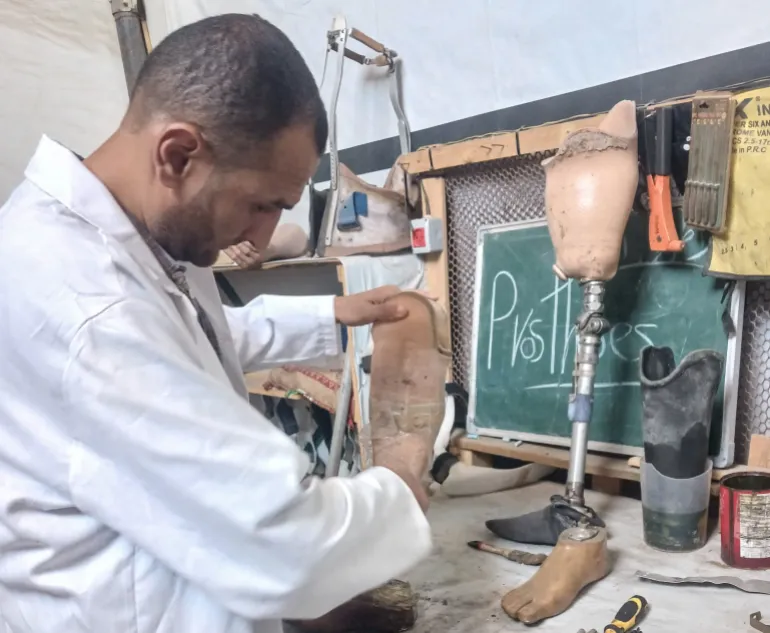
Inside a modest tent in al-Mawasi, southern Gaza, prosthetics and orthotics specialist Dr Mohammed al-Khalidi continues to assess patients, adjust devices and preserve access to rehabilitation care.
The tent has become his workplace after three clinics in which he previously practised were destroyed during the war.
His first clinic, situated on al-Bahr Street in Rafah, was destroyed in April 2024. Two further clinics in the Old City of Khan Younis were subsequently destroyed in May 2025.
Al-Khalidi recovered whatever equipment he could and established a temporary service inside a tent. He has now reportedly received patients from this improvised facility for approximately two years.
Care delivered despite unsuitable conditions
A tent cannot reproduce the controlled environment of a properly equipped prosthetic and orthotic facility.
Al-Khalidi works with limited space, unreliable electricity, high temperatures and constant surrounding noise. These conditions affect privacy, assessment, fabrication, storage and the safe use of tools and equipment.
Nevertheless, suspending the service would leave many patients without access to essential follow-up.
“Patients who need prosthetic limbs or orthotic devices cannot always wait until conditions return to normal,” he told Al Jazeera. Some are people with recent amputations, while others already use devices that require adjustment, maintenance or repair.
This distinction is critical. Supplying a prosthesis is not a single transaction. Residual limbs change, socket fit deteriorates, straps wear, joints become damaged and alignment may need to be reviewed. Without follow-up, a previously useful device can become painful, unsafe or impossible to wear.
More than 5,000 amputations estimated
The need for prosthetic services in Gaza has increased dramatically.
A May 2026 technical update from the World Health Organization estimated that more than 5,000 limb amputations had taken place since October 2023, with children accounting for approximately one in five amputees.
WHO estimated that 43,011 people had sustained potentially life-changing injuries and that between 49,462 and 55,914 injuries would require extended rehabilitation.
Among 2,277 amputees evaluated between September 2024 and May 2026, only 502 had received prostheses. Approximately 76% of the assessed amputations involved the lower limb, while 225 people required residual-limb revision surgery.
These figures demonstrate that demand cannot be met solely through short-term fitting campaigns. Gaza requires a sustained clinical system capable of surgery, rehabilitation, prosthetic and orthotic provision, repairs, replacement sockets and lifelong follow-up.
Only eight prosthetists reported
The WHO report identified just eight prosthetists working in Gaza as of May 2026.
This means that every experienced professional represents a substantial portion of the available workforce. When a clinician is killed, displaced, injured or loses a workshop, the consequences extend to hundreds of patients.
The destruction of al-Khalidi’s clinics therefore represents more than the loss of commercial property. It removes assessment rooms, fabrication areas, tools, machinery, patient records, stored materials and a reliable location through which patients can obtain continuing care.
Rebuilding the workforce must consequently be treated as seriously as replacing equipment. Gaza will need:
- Prosthetists and orthotists
- Rehabilitation technicians
- Physiotherapists and occupational therapists
- Orthopaedic and reconstructive surgeons
- Wound-care and diabetic-foot specialists
- Psychosocial support professionals
- Training, mentorship and professional education
- Administrative systems for referrals and patient follow-up
Why repairs are an essential service
Emergency responses frequently attract attention around the delivery of new prosthetic limbs. Yet repair and maintenance services may produce equally important benefits.
Damaged roads, rubble, uneven terrain and repeated displacement place exceptional loads on prostheses, wheelchairs, crutches and walking frames.
WHO has warned that Gaza’s damaged infrastructure and shortage of maintenance services are shortening the functional life of mobility products.
For an existing prosthetic user, replacing a strap, repairing a foot, restoring suspension or adjusting a socket may determine whether the person can obtain food, collect water, attend treatment or move through a displacement camp.
A functioning repair service also makes better use of scarce imported components. Not every technical problem should require the replacement of an entire device.
Severe supply constraints continue
Prosthetic and rehabilitation professionals are also working with limited access to materials and equipment.
WHO reported that no rehabilitation-facility equipment entered Gaza between May 2024 and April 14, 2026. At that point, 18 shipments containing assistive products were pending, with an average waiting time of 136 days and a reported maximum wait of 526 days.
Pending items included prosthetic limbs, wheelchairs, rehabilitation equipment, shower chairs and commodes.
No rehabilitation facility was considered fully functional. All were operating with significant shortages in staff, equipment or supplies.
For a prosthetic service, interrupted supply affects casting materials, thermoplastics, resins, reinforcement materials, liners, adapters, feet, knees, hand components and workshop consumables. Even where clinical expertise remains available, care cannot be sustained without a dependable material pathway.
Temporary clinics need structured support
Al-Khalidi’s tent service reflects professional commitment and local resilience. It should not, however, be treated as an acceptable long-term substitute for proper clinical infrastructure.
Temporary O&P services require support including:
- Reliable electricity and protected power systems
- Ventilation and temperature control
- Secure storage for tools, materials and patient records
- Clean areas for clinical assessment and fitting
- Workshop space separated from patient-care areas
- Dust and fume extraction
- Portable repair and alignment equipment
- Digital patient tracking
- Referral links with hospitals and rehabilitation teams
- Transport support for patients with limited mobility
- Protection for staff and patients
Mobile and modular workshops could help restore capacity while permanent facilities are rebuilt. Digital scanning may also reduce dependence on transporting plaster casts, but it cannot replace materials, fabrication equipment or clinical follow-up.
Rehabilitation is part of reconstruction
The wider Al Jazeera report describes doctors, teachers, engineers, accountants and traders converting tents into workplaces after offices, schools, clinics and shops were destroyed.
For Gaza’s amputees, access to work and education will also depend on rehabilitation.
A prosthesis, orthosis or mobility device can help a person return to employment, but only when it is accompanied by a suitable fit, training, repairs, accessible transport and an environment in which participation is possible.
Reconstruction must therefore include O&P workshops and rehabilitation centres alongside hospitals, homes, schools and commercial buildings.
Dr Mohammed al-Khalidi’s tent clinic is keeping an essential service alive under profoundly difficult conditions. Its existence is evidence of dedication—but also of the urgent need to rebuild permanent, properly equipped and locally led prosthetic and orthotic services.
- Al Jazeera: When Streets Become a Workplace—Gaza Workers Convert Tents into Offices
- WHO: Estimating Trauma Rehabilitation Needs in Gaza—May 2026 Update
- WHO Office for the Occupied Palestinian Territory