

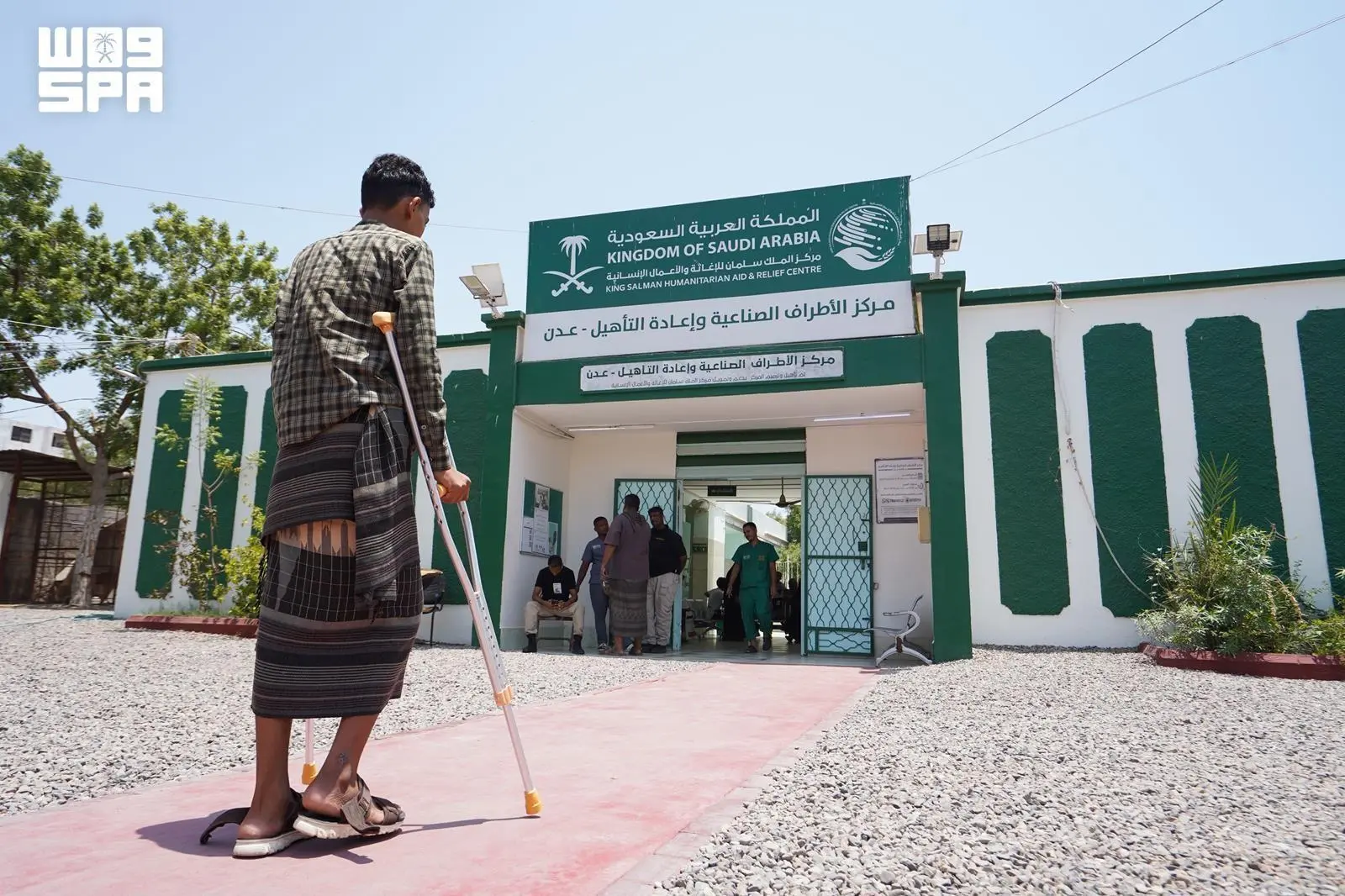
A prosthetics and rehabilitation centre supported by the King Salman Humanitarian Aid and Relief Centre provided services to 549 beneficiaries in Aden Governorate during September 2026.
According to KSrelief, the Prosthetics and Rehabilitation Center Project delivered 2,152 individual services during the month. These included prosthetic fitting and rehabilitation, physiotherapy and specialist medical consultations.
The figures illustrate the continuing demand for coordinated amputee rehabilitation in Yemen and the importance of maintaining permanent services capable of supporting patients beyond the initial delivery of a prosthetic limb.
Beneficiaries included residents and displaced people
Men represented 62% of the people receiving services, while women accounted for 38%.
Displaced people made up 55% of the beneficiary group, compared with 45% who were classified as local residents.
This distribution is significant for service planning. Displaced amputees may experience additional difficulties attending appointments, protecting their residual limbs and returning for repairs or adjustments. They may also lack secure accommodation, reliable transport and suitable environments in which to use a prosthesis.
Programmes serving displaced communities therefore require flexible appointment systems, effective patient records and clear referral arrangements so that care can continue if a person moves to another location.
More than one service per patient
The centre recorded almost four individual services for every beneficiary during September. Although the published figures do not specify how these interventions were distributed among patients, the ratio demonstrates that prosthetic rehabilitation involves multiple professional activities rather than a single device handover.
A typical pathway may include:
- Medical and functional assessment
- Residual-limb examination
- Measurement or casting
- Socket fabrication
- Trial fitting
- Static and dynamic alignment
- Physiotherapy and gait training
- Patient education
- Follow-up and adjustment
- Repair or component replacement
Some patients may need physiotherapy before they are ready to use a prosthesis, while others require repeated socket adjustments as their residual-limb volume changes.
The inclusion of specialist consultations and physiotherapy alongside prosthetic services indicates an effort to deliver a broader rehabilitation pathway.
Continuity is essential in humanitarian prosthetics
Humanitarian prosthetic programmes often face pressure to report the number of limbs produced or delivered. These figures are important, but they do not fully describe the care required by an amputee.
A prosthesis must remain comfortable, safe and functional in the user’s everyday environment. Sockets wear, components need inspection and patients’ bodies and mobility goals change over time.
This makes several elements essential:
- Availability of qualified prosthetists and orthotists
- Access to appropriate components and fabrication materials
- Trained technicians for maintenance and repair
- Physiotherapy and gait rehabilitation
- Patient education on skin and residual-limb care
- Documented follow-up
- Outcome measurement
- Replacement planning
Without these services, a prosthesis that initially fits well may eventually become painful or unusable.
The need for gender-responsive access
Women represented 38% of beneficiaries during the reporting period. The figures do not establish whether this reflects underlying need or differences in access.
Rehabilitation programmes should examine whether women and girls face additional barriers relating to transport, caregiving responsibilities, privacy, cultural expectations or access to female healthcare professionals.
Monitoring referral, attendance, fitting completion and follow-up by sex and age can help identify whether particular groups are underserved.
Similarly, paediatric patients require separate planning because growth can quickly affect socket fit, alignment and component length.
Strengthening the local rehabilitation system
KSrelief described the Aden project as part of Saudi Arabia’s continuing humanitarian work to strengthen Yemen’s health-sector capacity and reduce suffering.
For the O&P sector, sustainable capacity means investing in people and systems alongside equipment and components.
Centres need trained clinicians, technicians, physiotherapists, suitable workshops, quality-management processes and dependable supply chains. They must also maintain patient records that allow progress and device history to be monitored across repeated appointments.
Future reporting could strengthen understanding of the project’s impact by including:
- Number and level of prostheses fitted
- New patients compared with returning patients
- First-fit success and remake rates
- Waiting times
- Follow-up attendance
- Repairs and replacement sockets
- Functional outcome measures
- Return to education, work or community participation
- Patient satisfaction and device-use rates
These measures would show how service activity translates into lasting mobility and independence.
The September figures nevertheless demonstrate substantial continuing activity. By combining prosthetic provision with physiotherapy, rehabilitation and specialist consultation, the Aden centre is addressing a central principle of amputee care: the device is only one part of the patient’s rehabilitation journey.
- KSrelief: Aden Prosthetics Center Supports 549 Beneficiaries
- King Salman Humanitarian Aid and Relief Centre
- KSrelief project statistics