

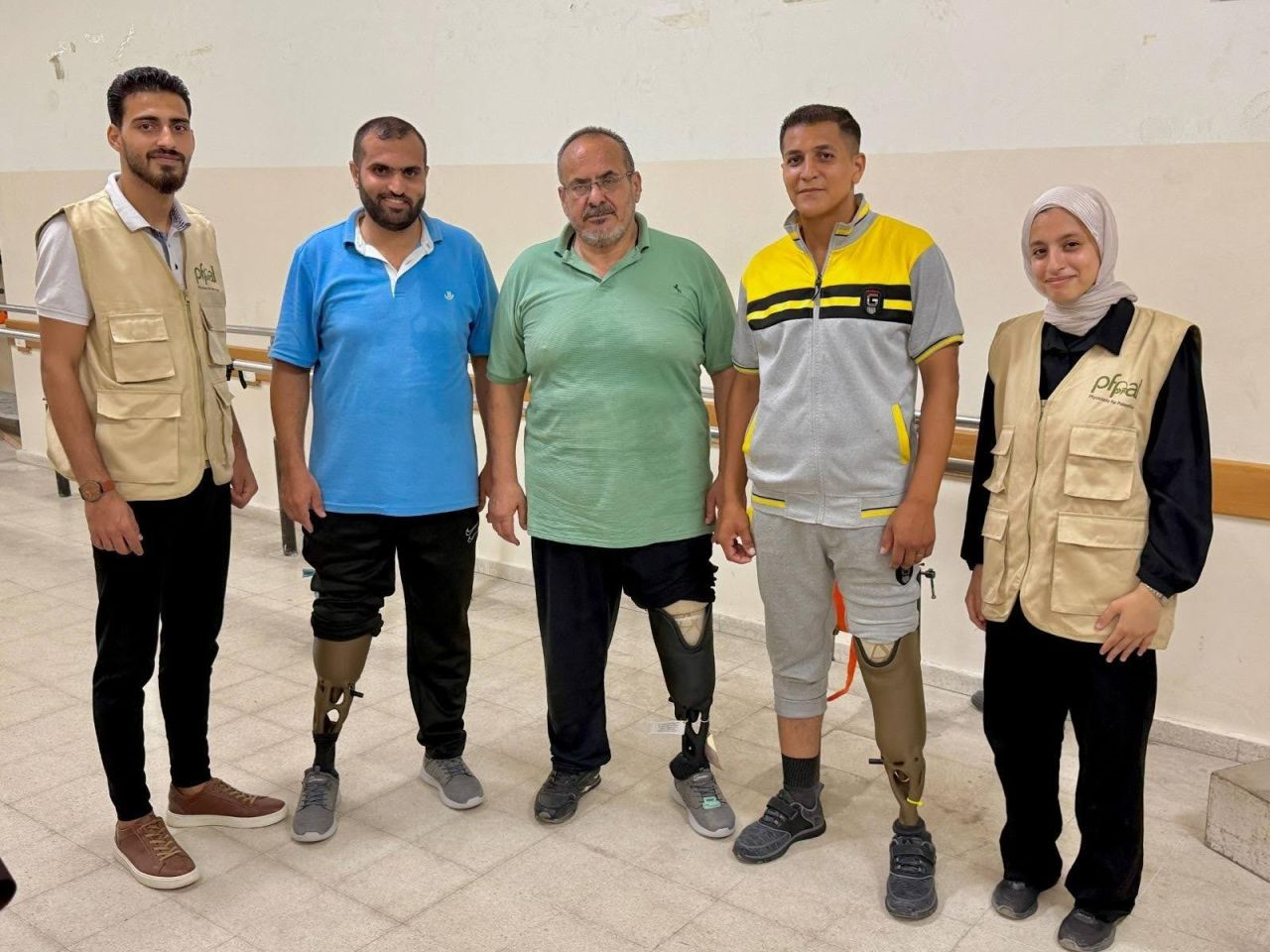
Physicians for Palestine is working to identify candidates for prosthetics and orthotics technician training as part of an effort to rebuild the local expertise needed to support amputees over the long term.
The initiative addresses a critical question that can easily be overlooked when attention focuses on the delivery of prosthetic limbs:
Who will fit, adjust, maintain and monitor the prosthesis after it reaches the patient?
A prosthesis is not a finished intervention that can simply be delivered and left with its intended user. It is a clinical device that must be fitted, aligned, evaluated and supported as the patient’s physical condition, activity and rehabilitation goals change.
Through its Prosthetics and Orthotics Education Program, Physicians for Palestine aims to help build the workforce required to provide this continuity of care.
Building more than a prosthetic-delivery programme
Physicians for Palestine launched its wider Prosthetics for Palestine programme with the Healing Hands Fund in response to increasing demand for amputee care in Gaza.
The organisation describes the programme as being centred on training, education and system-building, with the objective of strengthening local leadership and creating sustainable rehabilitation capacity.
Its longer-term vision includes developing prosthetic manufacturing laboratories and clinics alongside physical therapy, psychological care, nutritional support and continuing rehabilitation.
This approach recognises that successful prosthetic care involves considerably more than obtaining a component or manufacturing a socket.
A sustainable service must be able to provide:
- Patient assessment and prosthetic prescription
- Residual-limb evaluation and preparation
- Socket design, manufacture and fitting
- Static and dynamic alignment
- Gait training and functional rehabilitation
- Education on skin, limb and device care
- Repairs, replacement parts and consumables
- Management of volume and shape changes
- Outcome measurement
- Long-term clinical follow-up
Without local personnel capable of providing these services, even a well-made prosthesis can become uncomfortable, unsafe or unusable.
Why adjustment and maintenance matter
A patient’s residual limb can change considerably following amputation. Swelling may reduce, muscle volume can change and the person’s activity level may increase as rehabilitation progresses.
These changes affect socket fit and may require adjustments, additional socks, interface changes, socket replacement or reconsideration of the wider prosthetic prescription.
Children create an additional challenge because growth requires repeated reassessment and frequent replacement of sockets and other components.
A prosthesis also experiences everyday wear. Feet, knees, adapters, fasteners, suspension systems and cosmetic coverings must be inspected and maintained. Minor problems that could be corrected locally may otherwise cause skin injury, interrupt rehabilitation or result in device abandonment.
Training a local workforce therefore helps protect the clinical value of every prosthesis delivered.
Creating an appropriate workforce pathway
Technician education can expand essential fabrication, fitting-support, repair and maintenance capacity. However, training programmes must define roles and levels of responsibility clearly.
Technicians should work within a structured system that includes qualified prosthetists and orthotists, physiotherapists, rehabilitation physicians, surgeons, occupational therapists and other relevant professionals.
An effective education programme should address:
- Anatomy, biomechanics and amputation levels
- Materials, tools and workshop safety
- Socket-manufacturing techniques
- Component assembly and alignment
- Patient communication and safeguarding
- Recognition of pressure, pain and skin complications
- Maintenance and repair procedures
- Documentation and quality assurance
- Referral and clinical escalation
- Supervised practical experience
Short technical courses can respond to urgent service needs, but they should ideally form part of a progressive education pathway that allows participants to build recognised competencies and continue towards higher professional qualifications.
Local capacity creates continuity
External fabrication and international donations may help address immediate need, particularly when local infrastructure has been damaged or supply chains are restricted. They cannot, however, substitute permanently for functioning local services.
Physicians for Palestine has stated that the delivery of a prosthetic limb should be understood as the beginning of rehabilitation rather than the end. Its programme is being developed around three connected pillars: patient care, clinical education, and research and innovation.
This model can help ensure that experience gained through early fittings informs future socket designs, rehabilitation protocols and service-delivery decisions.
It can also create local employment, retain technical knowledge and reduce dependence on visiting teams.
Education protects every investment in technology
Funding prosthetic components without funding people creates an incomplete system. Laboratories need trained staff. Digital scanners require clinical understanding. Components need correct selection and alignment. Patients need rehabilitation and follow-up.
The Prosthetics and Orthotics Education Program is therefore not a secondary part of the response. It is central to whether prosthetic care can continue after individual missions, donations and shipments have ended.
By investing in Palestinian technicians and rehabilitation personnel, the programme is seeking to create something more durable than a single prosthesis: a locally led system capable of supporting amputees throughout their changing lives.
- Prosthetics for Palestine programme
- Support Prosthetics for Palestine
- Physicians for Palestine
- Physicians for Palestine education and training
- ISPO Palestine