

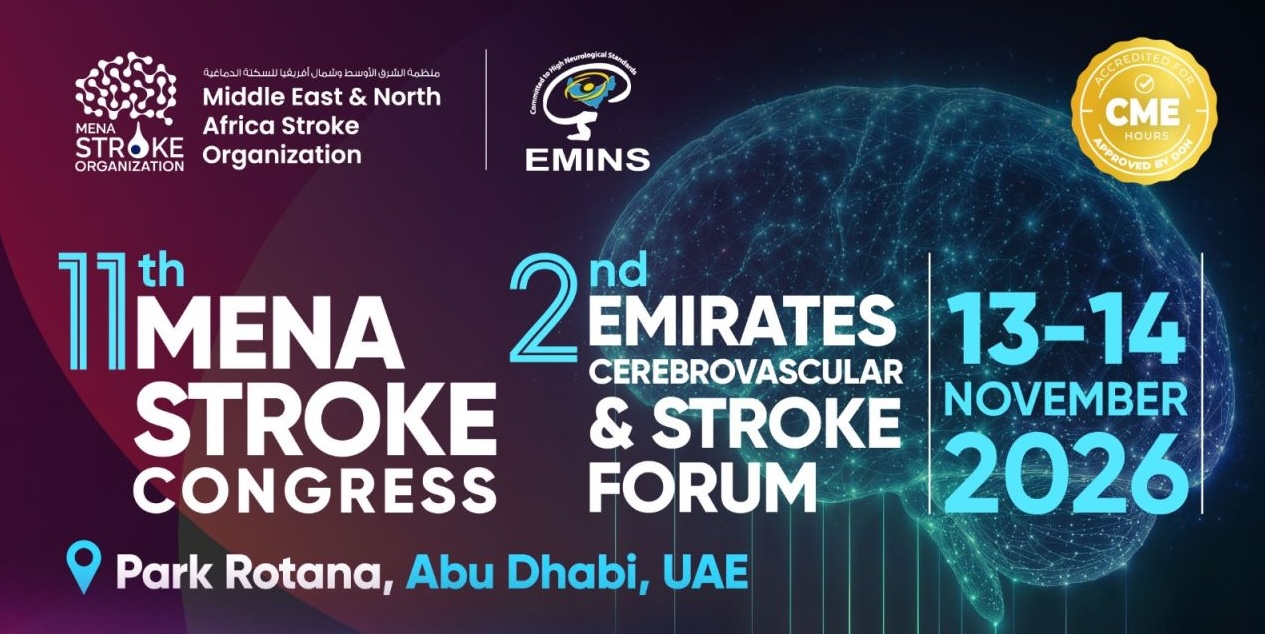
Healthcare professionals involved in stroke prevention, acute treatment and long-term rehabilitation will gather in Abu Dhabi for the 11th MENA Stroke Congress and 2nd Emirates Cerebrovascular & Stroke Forum on 13–14 November 2026.
Organised by the Middle East and North Africa Stroke Organization and EMINS, the two-day meeting will take place at the Park Rotana in Abu Dhabi. Continuing medical education hours have been approved by the Abu Dhabi Department of Health.
The official congress information identifies acute stroke management, neurointervention, advanced technology and post-stroke rehabilitation among the main programme themes.
Connecting acute care with long-term recovery
Stroke conferences have traditionally concentrated heavily on prevention, emergency response, imaging, thrombolysis and neurointervention. These remain critical, but survival is only the beginning of the patient journey.
Many stroke survivors experience lasting impairments affecting gait, balance, upper-limb function, communication, cognition and participation in everyday life. Effective management therefore requires a pathway extending from the emergency department into rehabilitation, community services and long-term follow-up.
The congress will bring together neurologists, stroke physicians, neurosurgeons, interventional radiologists, emergency clinicians, nurses, researchers, rehabilitation specialists and allied healthcare professionals.
The World Stroke Organization lists post-stroke rehabilitation and system-level strategies for improving patient outcomes among the meeting’s principal subjects.
For physiatrists, physiotherapists and CPOs, this multidisciplinary setting provides an opportunity to strengthen the connection between medical stabilisation and functional recovery.
TurboMed demonstrations for stroke-related foot drop
A practical feature for rehabilitation delegates will be demonstrations of TurboMed XTERN external ankle-foot orthoses for appropriately selected people experiencing foot drop following stroke.
Foot drop can reduce toe clearance during swing, increase the risk of tripping and contribute to compensatory movements at the knee, hip and pelvis. An AFO may be prescribed as part of the rehabilitation plan to support dorsiflexion, improve foot clearance and promote safer walking.
The planned demonstrations will enable clinicians to examine the external AFO concept and see how the device attaches outside the patient’s footwear.
Products demonstrated will include:
- XTERN Summit, developed for active users requiring dynamic foot-drop support
- XTERN Frontier, designed to make application easier, including for people with reduced hand dexterity
- ATX multi-size assessment equipment, allowing clinicians to trial the concept and evaluate potential users before prescribing an individually fitted device
TurboMed identifies stroke and dorsiflexion weakness among the clinical indications for its XTERN range. The company also states that the Summit sits entirely outside the shoe and supports shoe-to-shoe transfer, while the Frontier has been developed with the needs of users affected by reduced dexterity in mind.
Why hands-on assessment matters
A product demonstration should not be interpreted as evidence that one AFO is suitable for every person with stroke.
Orthotic selection should follow an individual assessment that considers:
- Dorsiflexor and plantarflexor strength
- Spasticity and muscle tone
- Passive ankle range
- Knee and hip control
- Fixed deformity
- Balance and cognition
- Skin condition and sensation
- Footwear
- Walking objectives
- Ability to apply and remove the device
TurboMed lists severe spasticity, fixed foot and ankle deformity, quadriceps weakness, severe proximal weakness and crouch gait among the clinical limitations associated with the XTERN Summit.
This makes collaboration between the rehabilitation physician, physiotherapist and orthotist essential. A demonstration can show how the technology behaves, but clinical assessment must determine whether it matches the patient’s presentation and treatment goals.
Strengthening regional stroke rehabilitation
The congress offers an important platform for ensuring that rehabilitation is discussed as a core component of stroke care rather than an intervention that begins only after the acute clinical priorities have ended.
For the regional O&P community, it is also an opportunity to show how orthotic assessment and timely access to appropriate devices can contribute to safer mobility, greater independence and improved participation.
The combination of scientific education, multidisciplinary discussion and practical technology demonstrations can help clinicians move from understanding post-stroke impairment to evaluating realistic solutions for individual patients.
Event Information
- Event: 11th MENA Stroke Congress and 2nd Emirates Cerebrovascular & Stroke Forum
- Dates: 13–14 November 2026
- Venue: Park Rotana, Abu Dhabi, UAE
- CME: Approved by the Abu Dhabi Department of Health
- Relevant audiences: Neurologists, physiatrists, CPOs, physiotherapists, nurses, rehabilitation teams and other stroke professionals
- Official congress website
- Congress registration
- Middle East and North Africa Stroke Organization
- TurboMed XTERN Summit
- TurboMed XTERN Frontier
- TurboMed Orthotics