

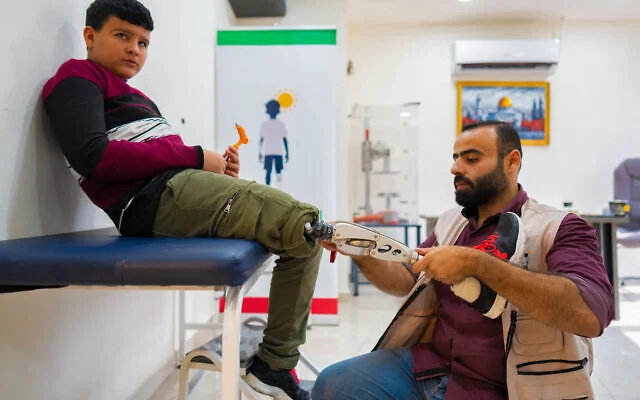
A Jordanian initiative is providing prosthetic care and rehabilitation to Palestinian amputees from Gaza, including teenagers adjusting to limb loss while separated from family and familiar routines. An AFP report published on 19 October 2026 describes the work of Jordan’s Restoring Hope Society, which says it is supporting more than 450 Palestinian amputees through services in Amman and Gaza.
Among those receiving care is Mahmoud Abou Nusair, who was 15 when he was injured in Deir al-Balah in October 2025. He told AFP that a bullet struck his right leg while he was looking for firewood. The injury worsened, and doctors later amputated below the knee. Mahmoud recalled initially resisting the decision, then agreeing after seeing other injured patients in hospital. He had enjoyed playing football and skating, and said he lost his sports equipment when his home was destroyed.
The report recounts Mahmoud’s account of how he was injured; it does not independently establish the circumstances of the incident. Keeping that distinction clear matters when reporting on individual experiences in a conflict setting.
Prosthetic care across borders
Seventeen-year-old Zuhdi Abou Shanab is receiving treatment with a prosthesis at a medical centre in Amman. He told AFP that he was injured in a strike in September 2025. After doctors attempted to repair damaged blood vessels in his right leg, an infection developed and the surgery was unsuccessful. The leg was amputated. Zuhdi said he hopes to return to Gaza and misses his mother and siblings.
The report also describes Abdulrahman Rihan, who lost the use of his legs after his family home in Jabalia was hit in January 2025. His father, Imad, sustained severe injuries and underwent a below-knee amputation. He told AFP that the family went through difficult operations and that he underwent some procedures without anaesthetic.
These accounts show how limb loss affects far more than an individual’s ability to walk. For young people, rehabilitation may also involve returning to school, sport and social life, while maintaining family connections and planning for adulthood. The report does not detail each person’s clinical pathway or prosthetic specification, so outcomes and treatment plans will differ from one case to another.
Individual goals shape rehabilitation
For prosthetists, orthotists and rehabilitation teams, adolescent care requires attention to growth, changing activity levels and the young person’s priorities. A prosthesis must be assessed and adjusted over time, with follow-up shaped by comfort, function and the person’s goals. Physiotherapy and support from family and peers can also help a young person build confidence using a device in daily life.
The experiences described in the report underline the importance of coordinated care: timely assessment, residual-limb management, prosthetic fitting, gait and mobility training, and ongoing review. Where treatment is delivered across borders, coordination between the receiving service, the patient and family, and care providers at home can be especially important for continuity.
The Restoring Hope Society’s programme is reported to be working with amputees both in Amman and Gaza. Its scale points to the substantial service needs facing affected communities, while the individual accounts highlight the need to centre each person’s circumstances and aspirations. For Mahmoud, that includes the possibility of playing football again; for Zuhdi, the hope of returning to his family.