 By
By
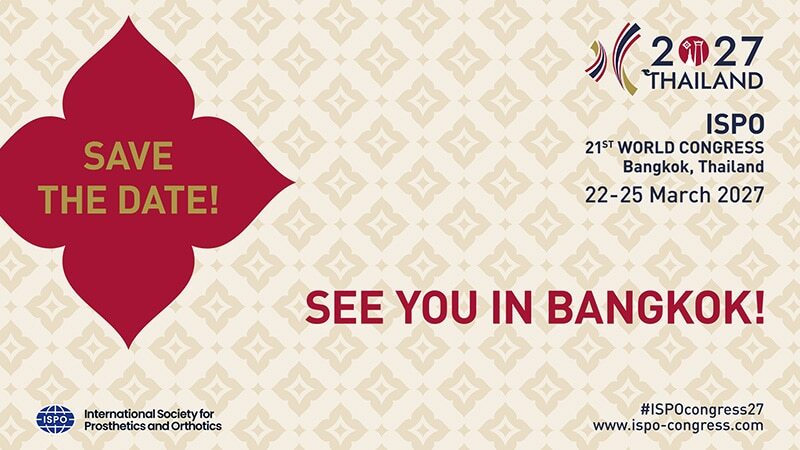
ISPO 2027 has revealed a keynote line-up that places rehabilitation systems, assistive technology, user-centred care, and next-generation mobility solutions at the heart of the next World Congress, underlining the event’s ambition to connect global expertise with real-world impact.
The ISPO 21st World Congress will take place in Bangkok from 22 to 25 March 2027, and the newly announced speakers reflect a deliberately broad view of the rehabilitation sector, spanning policy, service delivery, lived experience, and advanced technology.
According to the official congress announcement, the keynote programme is built around a central question: what does the future of rehabilitation look like, and how can innovation truly reach the people who need it most? That framing is especially relevant for prosthetics and orthotics professionals, as the field increasingly moves beyond component innovation alone toward wider questions of access, financing, service integration, and meaningful long-term outcomes.
Among the announced keynote speakers is Sisary Kheng of Cambodia, CEO of Exceed Worldwide, who is recognised for her work on integrating prosthetics and orthotics into national healthcare systems and moving beyond short-term aid models toward more sustainable rehabilitation solutions. ISPO says her work focuses on innovative financing and Universal Health Coverage, positioning mobility access as a fundamental right rather than a limited charitable intervention.
Also joining the keynote programme is Associate Professor Natasha Layton of Australia, whose work in assistive technology policy and outcomes has contributed to global frameworks including the WHO and UNICEF Global Report on Assistive Technology. The congress organisers describe her as a leading voice on ensuring that assistive solutions are not only innovative, but also accessible, measurable, and meaningful across different settings worldwide.
From Sweden, Professor Nerrolyn Ramstrand will bring a strong emphasis on lived experience and human-centred service delivery. According to ISPO, her research explores how prosthetics and orthotics services can respond more effectively to individual needs and real-world environments across different cultures, countries, and healthcare systems. That perspective is particularly important at a time when the sector is increasingly focused on person-centred care rather than purely device-led provision.
The technology and robotics dimension will be represented by Professor Massimo Sartori of the Netherlands, whose work on neuromuscular modelling and wearable technologies is helping shape the development of exoskeletons and bionic limbs aimed at restoring movement and improving quality of life after injury. His inclusion signals that ISPO 2027 will not only examine system reform and access, but also the cutting edge of rehabilitation engineering.
Beyond the scientific programme, the IC2A Inspirational Lecture will be delivered by Zy Kher Lee, described by the organisers as a young para-athlete and student whose story reflects resilience, determination, and barrier-breaking. ISPO notes that the Knud Jansen Lecture speaker will be announced later.
For IMEA CPOs, the significance of this keynote line-up goes well beyond conference promotion. The speaker mix closely mirrors the issues now shaping O&P growth across India, the Middle East, and Africa: stronger rehabilitation systems, sustainable financing, workforce development, outcomes-focused assistive technology, and the need to make innovation relevant in lower-resource or unevenly funded environments. That interpretation is an inference from the themes highlighted by ISPO and the practical challenges commonly seen across IMEA rehabilitation markets.
This has several implications for IMEA readers. First, the prominence of speakers focused on systems change and equitable access reinforces the importance of moving beyond one-off donations or isolated technology introductions toward stronger national service models. Second, the inclusion of experts in assistive technology outcomes and user-centred care highlights the growing need for IMEA CPOs to demonstrate value through evidence, measurable impact, and patient-relevant outcomes. Third, the robotics and wearable technology component points to a future in which advanced mobility solutions, including exoskeletons and bionic devices, will increasingly shape conversations around rehabilitation investment, training, and clinical readiness. These implications are reasoned conclusions based on the announced themes and speaker profiles.
For clinics, educators, ministries, NGOs, and private-sector O&P players in the IMEA region, ISPO 2027 is therefore likely to be more than a showcase of international expertise. It will also act as a signal of where the global profession is heading: toward integrated rehabilitation systems, stronger policy alignment, better measurement of impact, and wider access to both mainstream and advanced assistive technologies. For IMEA CPOs seeking to build more resilient and future-ready service ecosystems, those are exactly the conversations worth watching.