 By
By
Across much of the IMEA region, disability is rarely just a clinical issue.
It is social. Cultural. Sometimes deeply emotional.
Families worry about stigma. Young people fear judgment at school or at work. Many patients ask the same first question — not:
“What’s the safest way to walk again?”
but rather:
“How can we make it look like nothing is wrong?”
This instinct is understandable. In many communities, visible disability can be linked to shame, pity, or misunderstanding — especially when traditions emphasize strength, dignity, and “not showing weakness.”
But when aesthetics become the primary goal, it can quietly push clinicians and families toward solutions that hide disability rather than solve the functional problem.
Foot drop is a perfect example.
The quiet pressure to hide foot drop
Foot drop affects gait, safety, independence, and long-term joint health.
Yet culturally, many patients are encouraged to:
-
choose smaller braces that disappear inside the shoe
-
avoid devices that look “orthopaedic”
-
prioritise appearance over biomechanics
This is where in-shoe carbon fiber AFOs often become the default recommendation:
✔ slim
✔ discreet
✔ fits inside footwear
✔ easy to “hide”
But there is a trade-off: hiding the brace does not automatically mean better walking, safer gait, or long-term comfort. And for many patients — especially active adults across IMEA — those hidden braces can create new frustrations.
The limitations of in-shoe carbon AFOs
Carbon AFOs absolutely have their place. For the right indication, they are lightweight, supportive, and effective.
But they are not magic — and not always the best first choice for cultural environments where shoes change frequently, heat is high, terrain is uneven, and mobility demands are significant.
Common challenges include:
• They live inside the shoe
Patients are restricted to certain footwear. Sandals, traditional footwear, or barefoot at home? Often impossible.
• Pressure and friction
Heat + sweat + rigid materials = irritation, blisters and skin breakdown — especially in diabetic or neuropathic feet.
• Limited ankle freedom
Many carbon AFOs restrict natural ankle movement, affecting squatting, kneeling in prayer, climbing stairs, or sitting cross-legged — daily activities in IMEA life.
• Replacement costs
Carbon devices fatigue and crack over time. With limited insurance coverage across many IMEA countries, replacing them is expensive.
• “Invisible brace” expectations
Because the brace is hidden, families assume the problem has “gone away” — and patients push beyond safe limits, risking falls.
Most importantly:
The brace adapts the foot to the brace — instead of adapting the brace to the lifestyle.
And lifestyle matters.
Why the TurboMed Xtern Classic+ changes the discussion
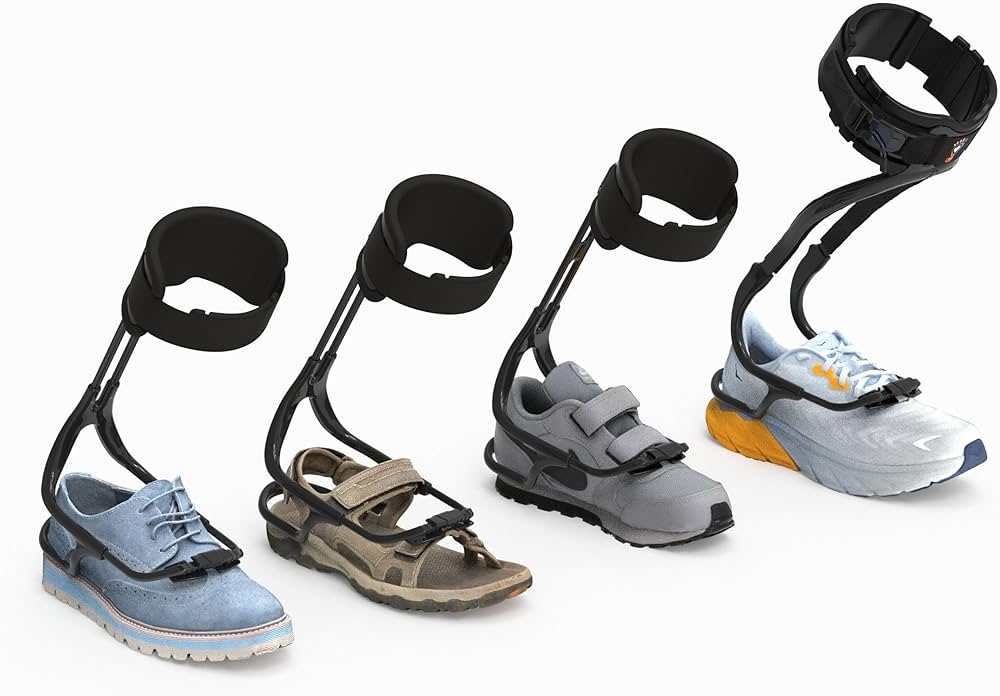
The TurboMed Xtern Classic+ approaches foot drop differently.
It is not worn inside the shoe.
It does not contact the foot.
It attaches externally — outside the shoe, acting almost like an exoskeleton.
That one design shift solves many problems IMEA patients face.
Foot freedom, skin protection
Because the Xtern doesn’t sit inside the shoe:
-
no pressure on bony prominences
-
dramatically lower risk of skin irritation
-
safer for neuropathy and diabetes
-
more comfort in hot climates
Patients can keep barefoot time at home, change footwear, wear sandals — and still benefit from functional support when they need it.
Natural ankle mechanics
The Xtern supports dorsiflexion while allowing controlled plantarflexion.
That means:
✔ easier kneeling and rising
✔ more natural gait cycle
✔ better navigation on uneven ground
✔ improved ability to squat, climb stairs, and perform daily tasks
This aligns better with cultural activities, community life, and prayer positions.
Truly functional — not cosmetic
Instead of hiding disability, the Xtern:
-
restores swing phase clearance
-
reduces trips and falls
-
protects joints from compensatory gait patterns
-
supports long-term independence
And because it remains durable and adjustable, replacement happens less frequently than with fragile carbon frames.
Shoe flexibility
Patients no longer need “special” orthotic footwear.
They can use:
-
sports shoes
-
work boots
-
traditional shoes
-
multiple pairs without modification
This restores autonomy — and in many cases, dignity.
Rethinking the IMEA mindset: Visible support is not shame — it is strength
Cultural sensitivity matters. We must never dismiss concerns about stigma. But our job as clinicians and advocates is to reframe the narrative:
A visible brace is not weakness.
A visible brace is independence, safety, and participation.
The question for IMEA health systems should shift from:
“Can we hide it?”
to:
“Can this person walk farther, safer, longer — with fewer complications?”
In many cases, that answer leads not to an in-shoe carbon AFO, but to external, dynamic systems like the TurboMed Xtern Classic+.
Not because it is trendy.
But because it respects:
✔ biomechanics
✔ daily life
✔ cultural realities
✔ long-term safety
And most importantly — the person wearing it.
Final thought
IMEA healthcare is evolving. Communities are talking more openly about disability. Patients are asking smarter questions. Our role is to guide them gently toward solutions that serve life — not just appearance.
Sometimes, the best brace is the one you can see.



.jpeg)

-1.png "Gaza Fund (1)-1")