 By
By
The global foot and ankle devices market continues to attract attention as demand grows for solutions that improve mobility, reduce fall risk and support functional independence. Recent market reporting points to strong expansion ahead, with one Yahoo Finance-posted market update citing projected growth at around 8% CAGR through 2034. While broad market reports often group together many categories of products, one of the clearest areas of practical clinical relevance is the continued demand for external devices for foot drop.
For orthotics and prosthetics professionals, that matters because foot drop is not a niche presentation. It is a common functional problem associated with neurological injury, peripheral nerve damage, stroke, multiple sclerosis, trauma and other conditions that weaken or paralyse the muscles responsible for dorsiflexion. Clinical references describe foot drop as difficulty lifting the front part of the foot during gait, often leading to toe drag, altered walking patterns and increased risk of trips and falls.
In this context, the most relevant market story is not about surgical hardware. It is about external fitted devices that can be prescribed, adjusted and integrated into everyday rehabilitation pathways. These include ankle-foot orthoses, foot drop splints and shoe-mounted dynamic systems designed to help lift the forefoot during swing phase and improve safer, more efficient walking. Mainstream clinical guidance continues to identify braces and splints as a standard conservative option for managing foot drop.
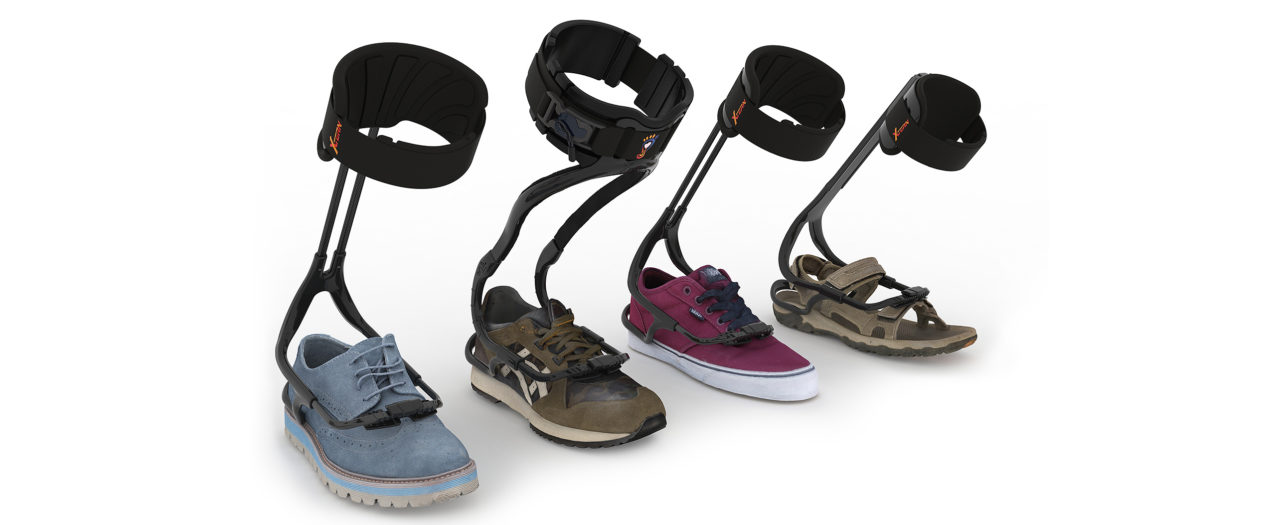
Among the more distinctive products in this space is TurboMed, which has built visibility around an external AFO concept rather than a traditional in-shoe brace. According to the manufacturer, the TurboMed XTERN is designed as a modular external ankle-foot orthosis that mounts to the outside of footwear and functions as an exoskeletal support for the impaired limb. The company says this configuration is intended to improve function while reducing the rubbing, pressure and skin contact often associated with more conventional brace designs.
That external-mount concept is clinically significant because many users with foot drop struggle not only with dorsiflexion weakness, but also with comfort, shoe fit, skin tolerance and ease of donning. Traditional internal braces can be effective, but they may be limited by footwear compatibility, pressure issues or reduced tolerance in some users. TurboMed’s external format is positioned as an alternative for patients who need functional lift while preserving internal shoe space and minimising direct contact with the skin. Independent orthotic service providers describing the device similarly note that it attaches externally and provides a spring-like lift to the foot, with suitability determined through orthotist assessment and footwear compatibility.
This is one reason external foot drop devices are gaining attention in the wider market. They align with several strong demand drivers at once: the rising prevalence of neurological conditions, the need for practical non-invasive mobility solutions, growing interest in community-based rehabilitation, and patient demand for devices that can support active daily life rather than simply provide static positioning. These factors help explain why foot and ankle device market growth is increasingly relevant to orthotics-focused rather than only orthopaedic-surgical conversations.
TurboMed also stands out because it is marketed not just as a clinic-room brace, but as a solution intended to support walking across varied real-world settings. The company describes its XTERN range as suitable for walking and running and emphasizes modularity, footwear interchangeability and options for users with reduced hand dexterity, including the XTERN FRONTIER design. That kind of product positioning reflects a broader market move toward function-first orthotic solutions that are less about simple immobilisation and more about enabling activity, participation and independence.
For clinicians, this changes the conversation. The question is no longer only whether a patient needs dorsiflexion assistance. It is also which external solution best fits the person’s gait pattern, footwear habits, skin condition, hand function, activity goals and rehabilitation pathway. In some cases, a soft or rigid in-shoe foot drop brace may still be appropriate. In others, a more visible but externally mounted device such as TurboMed may offer better compliance and day-to-day usability. That is a clinical selection issue rather than a one-size-fits-all product decision, but it is exactly where specialist orthotic assessment adds value. The sources describing TurboMed repeatedly emphasise assessment, fitting and compatibility rather than generic self-selection.
From a market perspective, external foot drop devices also fit well with broader healthcare trends. They are non-invasive, scalable and compatible with outpatient rehabilitation, neuro-rehab, post-stroke care and private orthotic practice. They can also be easier to integrate into service models that prioritise mobility restoration without surgery. As health systems and private providers look for lower-risk, function-oriented interventions, devices in this category are well positioned to benefit. That is an inference from the market growth outlook and the established role of braces in foot drop care.
The bigger takeaway is that foot drop should be viewed as an important functional segment within the wider foot and ankle devices market, not just as a secondary indication. And within that segment, external fitted devices are becoming increasingly relevant because they address a real clinical need with a practical, conservative and often immediately deployable intervention. TurboMed is one of the clearest examples of this shift: a product built around external support, daily function and user tolerance rather than invasive treatment pathways.
As the market continues to grow, the most meaningful opportunities for orthotics and prosthetics providers are likely to be in products and services that improve real-world gait, comfort and compliance. In that sense, the future of the category may be shaped less by what happens in the operating theatre and more by what helps patients walk better outside it.
- Global Foot and Ankle Devices Market to Observe Stunning Growth at a CAGR of ~8% by 2034
- TurboMed XTERN external ankle-foot orthosis
- TurboMed orthotics homepage
- Mayo Clinic: Foot drop diagnosis and treatment
- NCBI StatPearls: Foot Drop
- PhysioFunction: TurboMed XTERN AFO overview
- Orthotics.co.uk: TurboMed XTERN