 By
By
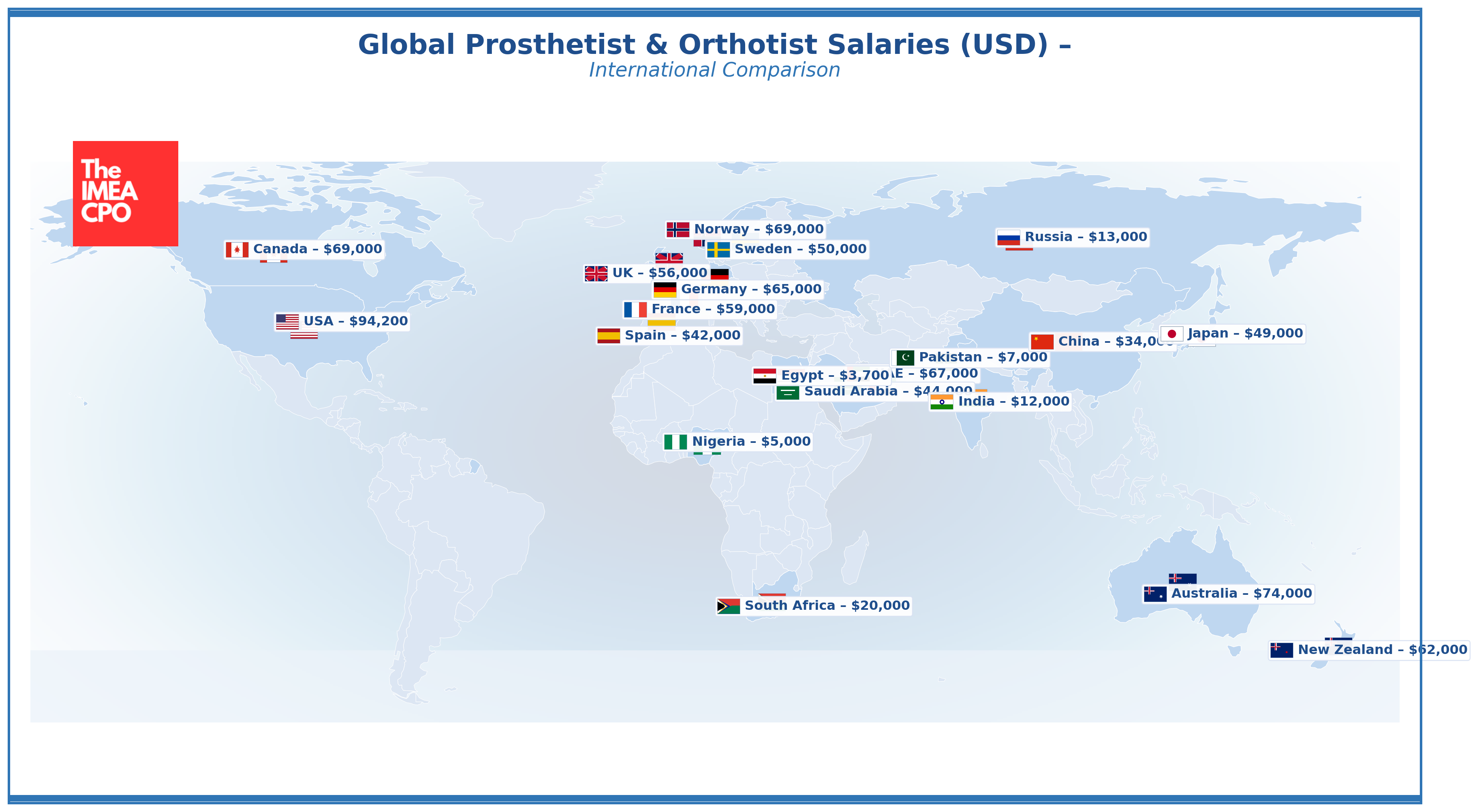
Salaries for certified prosthetists and orthotists vary widely across the world, reflecting differences in healthcare funding models, reimbursement systems, workforce supply, and the maturity of rehabilitation services. While the profession is highly specialised everywhere, the financial rewards can range from relatively modest public-sector salaries in developing markets to strong six-figure earnings in advanced healthcare systems.
It is important to note that not every country uses the exact CPO (Certified Prosthetist-Orthotist) designation, so international comparisons are based on the closest equivalent clinical roles. Figures below represent approximate gross annual salaries, with USD equivalents shown for comparison.
In North America, the profession remains one of the better-paid allied health careers. In the United States, the average salary for a certified prosthetist-orthotist is about $94,200 USD ($94,200 USD) per year, with experienced clinicians and private-sector specialists earning significantly more. In Canada, average pay is approximately C$93,458 (~$69,000 USD), with higher earnings possible in urban rehabilitation centres or private clinics.
In the United Kingdom, many clinicians work within the NHS pay structure rather than individual contracts. Prosthetists and orthotists are commonly employed at Band 6 or Band 7 level, with salaries typically ranging from £38,682 to £46,580 (~$49,000–$59,000 USD) for Band 6 and £47,810 to £54,710 (~$61,000–$70,000 USD) for Band 7. While lower than US salaries, the UK system offers predictable progression and strong job security.
Across continental Europe, salaries tend to sit in the middle range of global earnings. In Germany, average annual pay is around €60,065 (~$65,000 USD), while in France it is about €54,577 (~$59,000 USD) and in Spain roughly €38,931 (~$42,000 USD). In Scandinavia, strong public healthcare systems provide stable incomes, with averages around NOK 741,998 (~$69,000 USD) in Norway and SEK 523,281 (~$50,000 USD) in Sweden. Russia, by contrast, reports much lower averages at about RUB 1,221,003 (~$13,000 USD), reflecting broader economic differences.
In the Gulf region, salaries vary depending on whether employment is in government hospitals, private clinics, or international providers. In the United Arab Emirates, average pay is around AED 244,942 (~$67,000 USD), while in Saudi Arabia it is approximately SAR 166,600 (~$44,000 USD). In Qatar and Kuwait, salaries can range widely but often fall between $45,000 and $75,000 USD, particularly when housing or tax benefits are included. The absence of income tax in many Gulf countries makes these packages attractive to expatriate clinicians even when base salaries are lower than in North America.
In Africa and the Middle East outside the Gulf, pay levels are considerably lower. In Egypt, the average prosthetist-orthotist salary is around EGP 182,569 (~$3,700 USD), while in South Africa it is approximately ZAR 380,349 (~$20,000 USD). These figures reflect limited reimbursement systems and reliance on public or donor-funded rehabilitation services.
Across South Asia, salaries remain modest despite growing demand for rehabilitation. In India, average pay is about INR 993,111 (~$12,000 USD), while in Pakistan it is around PKR 1,959,427 (~$7,000 USD). However, both countries are seeing increasing investment in private healthcare and digital fabrication, which may gradually improve earnings.
In East Asia, pay levels vary widely. Japan reports relatively strong salaries at about JPY 7,393,531 (~$49,000 USD), reflecting a mature healthcare system, while in China the average is approximately CNY 246,219 (~$34,000 USD), with higher wages possible in major cities and private hospitals.
Among English-speaking countries outside North America, Australia and New Zealand remain attractive destinations for prosthetists and orthotists. Average salaries are about AUD 112,868 (~$74,000 USD) in Australia and NZD 102,774 (~$62,000 USD) in New Zealand, with good working conditions and strong demand for experienced clinicians.
Looking across all regions, several clear patterns emerge. The highest salaries are generally found in the United States, Canada, Australia, Norway, and parts of the Gulf, while Western Europe offers moderate but stable pay. Developing markets often offer lower cash salaries but may present opportunities due to rapid growth in rehabilitation services, expanding diabetes-related care, and increasing use of modern fabrication technologies.
For many prosthetists and orthotists, the best career opportunities are not defined by salary alone. Licensing requirements, reimbursement systems, taxation, working conditions, and access to advanced technology all play a major role in deciding where clinicians choose to work. As global demand for rehabilitation continues to rise, especially with aging populations and increasing chronic disease, the profession remains one of the few allied health fields with strong international mobility and long-term growth potential.