 By
By
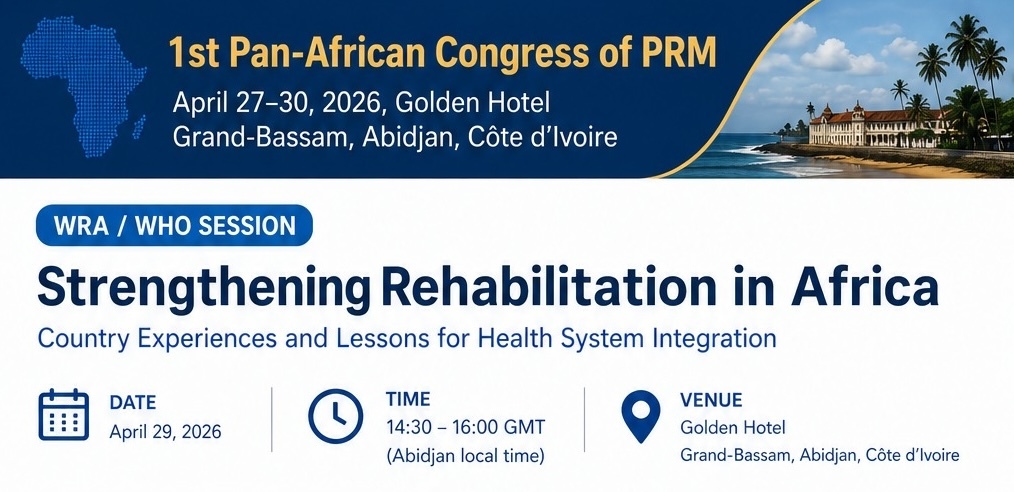
A major hybrid session dedicated to “Strengthening Rehabilitation in Africa” will take place on April 29, 2026, as part of the 1st Pan-African Congress of Physical and Rehabilitation Medicine in Abidjan, Côte d’Ivoire. The session is jointly connected to the World Health Organization, the World Rehabilitation Alliance and the International Society of Physical and Rehabilitation Medicine, bringing together speakers from across Africa, Europe and Asia to discuss how rehabilitation can be better integrated into African health systems.
The session will be held from 14:30 to 16:00 GMT in the Emerald Room, Golden Hotel, Grand-Bassam, with online participation also available. Registration is open to all, making this an important opportunity for clinicians, rehabilitation professionals, prosthetists, orthotists, policy-makers, NGOs, researchers and assistive technology stakeholders across the region.
For the IMEA rehabilitation and O&P community, this event is significant. It comes at a time when rehabilitation is increasingly recognised as an essential health service, not an optional add-on after acute care. The WHO Rehabilitation 2030 initiative highlights the profound unmet need for rehabilitation worldwide and calls for stronger health systems capable of delivering rehabilitation services closer to the people who need them.
Why This Session Matters
Across Africa, demand for rehabilitation is growing. Road traffic injuries, conflict-related trauma, stroke, diabetes, childhood disability, cerebral palsy, spinal cord injury, limb loss, ageing populations and non-communicable diseases are all increasing the need for long-term rehabilitation, prosthetics, orthotics and assistive technology.
Yet rehabilitation services remain underdeveloped in many health systems. Patients may survive injury or illness but then struggle to access physiotherapy, occupational therapy, prosthetic and orthotic care, mobility aids, speech therapy, psychosocial support or community reintegration. This gap has direct consequences for independence, employment, education, family life and dignity.
The World Rehabilitation Alliance was created as a WHO global network to support the implementation of the Rehabilitation 2030 initiative through advocacy. Its work promotes rehabilitation as an essential health service that is integral to Universal Health Coverage and Sustainable Development Goal 3: ensuring healthy lives and promoting wellbeing for all.
This makes the Abidjan session more than a professional meeting. It is part of a wider movement to place rehabilitation within mainstream health policy, financing and service delivery across Africa.
A Pan-African and International Speaker Faculty
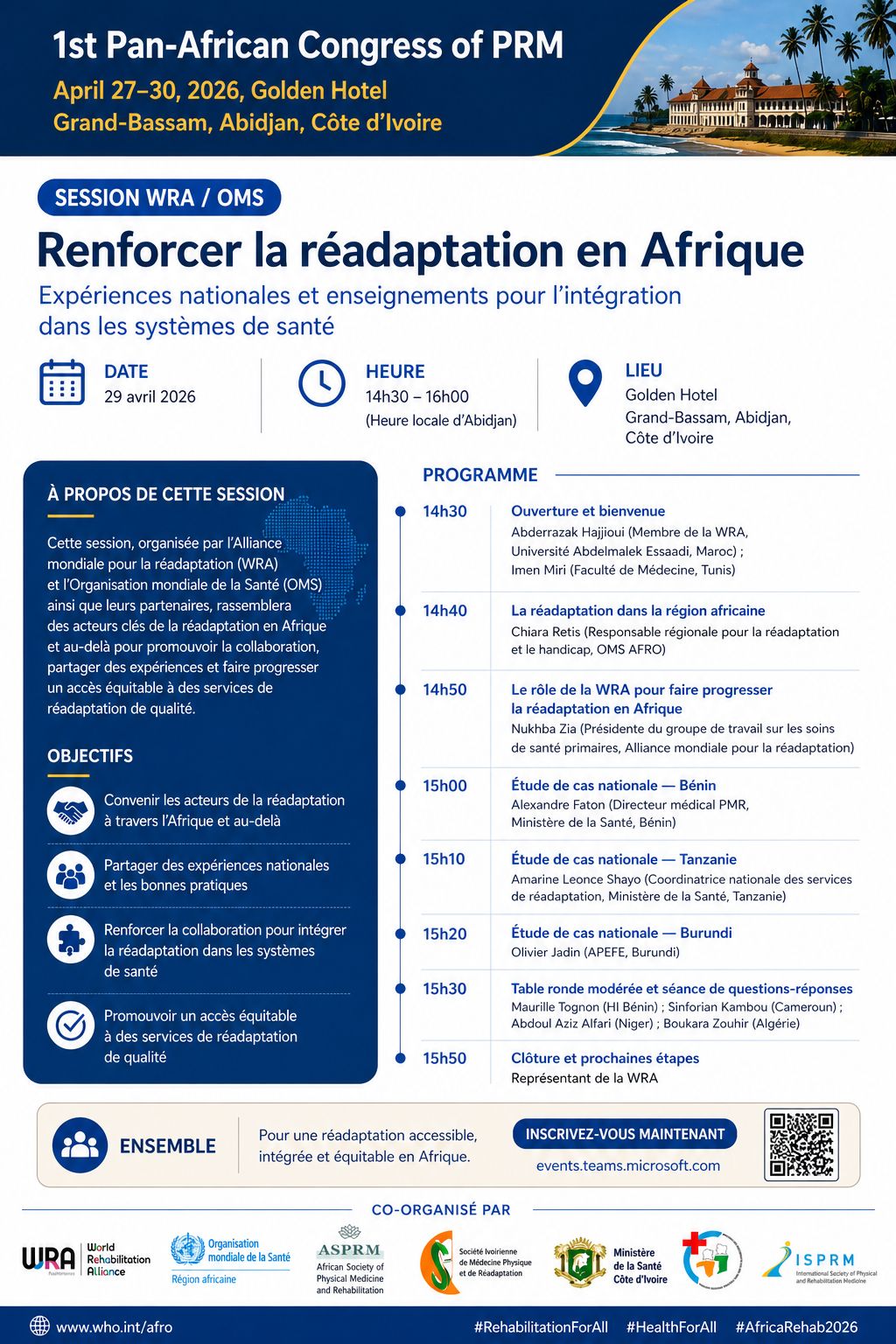
The session brings together a broad international faculty, reflecting the need for both African country leadership and global collaboration.
Speakers include:
- Prof. Abderrazak Hajjioui – World Rehabilitation Alliance, Morocco
- Dr Miri Imen – former President, Société Tunisienne de Médecine Physique et de Réadaptation, Tunisia
- Chiara Retis – WHO AFRO
- Nukhba Zia – World Rehabilitation Alliance, Pakistan
- Alexandre D. Faton – Ministry of Health, Benin
- Amarine Leonce Shayo – Ministry of Health, Tanzania
- Olivier Jadin – APEFE Burundi
- Agbogbê R. Maurille Tognon – Handicap International / Humanity & Inclusion, Benin
- Sinforian Kambou – Cameroon
- Abdoul Aziz Alfari – Abdou Moumouni University, Niamey, Niger
- Zouhir Boukara – President of SAMER, Algeria
The speaker list reflects a practical and policy-focused agenda. It includes ministries of health, universities, rehabilitation societies, NGOs, WHO AFRO and the World Rehabilitation Alliance. That mix is essential because rehabilitation cannot be strengthened by one profession or one institution alone. It requires coordination across clinical care, policy, education, financing, service delivery and community inclusion.
Session Objectives
The session aims to:
- Share country experiences and best practices
- Identify challenges and key enablers for integrating rehabilitation into health systems
- Strengthen regional collaboration
- Promote equitable access to quality rehabilitation services
These objectives are closely aligned with the priorities of Universal Health Coverage in Africa. Rehabilitation must be available not only in major hospitals or capital cities, but also through regional centres, district hospitals, community-based services and primary healthcare pathways.
What This Means for Prosthetics and Orthotics
For prosthetics and orthotics professionals, the session is highly relevant. O&P services sit at the intersection of rehabilitation, assistive technology, surgery, physiotherapy, social inclusion and long-term disability support.
A person who loses a limb requires more than emergency surgery. They need residual-limb care, prosthetic assessment, socket fitting, alignment, gait training, repairs, replacement parts and long-term follow-up. A child with cerebral palsy may need orthotic management, physiotherapy, seating, family education and school inclusion. A person with diabetic foot complications may need early screening, footwear, insoles, offloading, wound care referral and prevention support before amputation occurs.
These are not separate from health-system strengthening. They are part of it.
If rehabilitation is integrated properly into African health systems, O&P services should become more visible, better planned and more consistently financed. That means:
- Better referral pathways from hospitals and primary care
- Stronger links between surgery, rehabilitation and O&P workshops
- Improved access to prosthetic and orthotic devices
- Workforce development for prosthetists, orthotists, technicians and rehabilitation teams
- Better supply chains for components and fabrication materials
- Greater recognition of assistive technology within public health planning
- Long-term maintenance and repair systems for users
From Advocacy to Implementation
The global rehabilitation agenda has gained momentum in recent years. In 2023, the World Health Assembly adopted a landmark resolution on strengthening rehabilitation in health systems, calling for rehabilitation to be incorporated across all levels of healthcare and supported through better financing. The resolution responded to a global situation where rehabilitation needs remain widely unmet.
The challenge now is implementation.
For African countries, this means translating global commitments into national rehabilitation strategies, workforce plans, service packages, financing mechanisms and measurable outcomes. It also means recognising that rehabilitation is not only for people with permanent disabilities. It benefits people recovering from injury, stroke, surgery, cancer, burns, neurological disease, musculoskeletal conditions and many other health challenges.
The Abidjan session provides a platform to move this conversation from principle to practice. Country experiences from Benin, Tanzania, Burundi, Cameroon, Niger, Algeria and other contributors can help identify what is working, where the barriers remain, and how regional collaboration can accelerate progress.
Why Regional Collaboration Is Essential
No single country can solve Africa’s rehabilitation challenge alone. Many countries face common barriers: limited workforce numbers, underfunded services, lack of assistive technology data, weak referral pathways, shortages of devices and materials, and limited integration into national health insurance or public procurement systems.
Regional collaboration can help by supporting:
- Shared training models
- Professional exchange between countries
- Joint advocacy for rehabilitation financing
- Regional clinical guidelines and standards
- Data collection on rehabilitation and assistive technology need
- Partnerships between ministries, universities, NGOs and professional societies
- Greater visibility for rehabilitation in African health policy
The Pan-African setting of this session is therefore important. It recognises that rehabilitation in Africa must be strengthened through African leadership, while also drawing on global expertise and international support.
A Call to the IMEA Rehabilitation Community
This session deserves strong support from the wider rehabilitation, O&P and assistive technology community. It is relevant to physical and rehabilitation medicine specialists, prosthetists, orthotists, physiotherapists, occupational therapists, rehabilitation nurses, speech therapists, NGOs, academic institutions, device manufacturers, policy-makers and service planners.
For O&P professionals in particular, the message is clear: prosthetics and orthotics should be part of every serious conversation about rehabilitation system strengthening in Africa. Devices, workshops and clinical skills must be connected to national rehabilitation policy, universal health coverage, workforce planning and equitable access.
Outlook
The Strengthening Rehabilitation in Africa session at the 1st Pan-African Congress of Physical and Rehabilitation Medicine represents an important step for regional dialogue and action. By bringing together WHO, WRA, ISPRM, ministries of health, universities, NGOs and rehabilitation leaders, the session creates a timely platform to address one of the continent’s most urgent health-system priorities.
Rehabilitation enables people to move, communicate, work, learn, recover and participate. For Africa, strengthening rehabilitation is not only a clinical priority. It is a development priority, a disability inclusion priority and a Universal Health Coverage priority.
The IMEA CPO community should support this initiative and follow the outcomes closely. The future of rehabilitation in Africa will depend on stronger systems, better workforce planning, more inclusive services and sustained collaboration across countries and professions.
Event Details
Event: Strengthening Rehabilitation in Africa – Hybrid Session
Date: April 29, 2026
Time: 14:30–16:00 GMT
Venue: Emerald Room, Golden Hotel, Grand-Bassam, Côte d’Ivoire
Format: Hybrid, in-person and online
Context: 1st Pan-African Congress of Physical and Rehabilitation Medicine, Abidjan
Registration: Register here
- Registration link for the Strengthening Rehabilitation in Africa session
- World Rehabilitation Alliance
- WHO Rehabilitation 2030 Initiative
- International Society of Physical and Rehabilitation Medicine
- WHO Rehabilitation in Health Systems
- WHO and UNICEF Global Report on Assistive Technology
- World Health Assembly rehabilitation resolution coverage
- International Society for Prosthetics and Orthotics