

Hike Medical’s $22.5 million funding announcement is a technology and investment story, but its foundations lie in three generations of orthotic and prosthetic practice.
The San Francisco-based company was co-founded by Aadi Bhanti, whose grandfather handcrafted orthotic devices in India. His father, Amit Bhanti, trained in prosthetics and orthotics in India before moving to the United States and building a large multi-state O&P clinical network.
The third generation is now applying artificial intelligence, mobile scanning, integrated software and large-scale additive manufacturing to the delivery of custom devices.
For the global O&P community—and particularly professionals across the Middle East, Africa, Central Asia and South Asia—the family’s journey offers an example of how clinical heritage can combine with technology and commercial ambition.
Hike Medical Raises $22.5 Million
Hike Medical has raised $22.5 million across Seed and Series A financing to expand its integrated platform for orthotics, prosthetics and durable medical equipment.
The investment was led by Max Altman of Saga Ventures, with participation from Indicator Ventures, Fifth Down Capital, RiverPark Ventures and strategic investor Orthofeet. Angel investors included Sam Blond and former American football player and coach Jerod Mayo.
The company intends to use the capital to recruit engineering and sales personnel in San Francisco, expand manufacturing in Peoria, Illinois, and move beyond its initial concentration on custom foot orthoses.
Hike’s leadership includes co-founders Aadi Bhanti, CEO, and Steven Chacko, Chief Business Officer. Amit Bhanti serves as Chief Clinical Officer, while logistics and technology executive Jerry Tang has joined as Chief Operating Officer.
Three Generations of O&P Experience
Aadi Bhanti describes his grandfather as a practitioner who made orthoses by hand in India, fitting devices through practical skill, experience and direct observation.
The second generation carried this clinical heritage into the United States. According to the American Orthotic and Prosthetic Association, Amit Bhanti earned his P&O qualification in India before completing graduate studies at Northwestern University in 2000.
In 2005, he co-founded Comprehensive Prosthetics & Orthotics in Peoria, Illinois. The organisation subsequently grew into a network of more than 30 clinics across several US states.
This gave Aadi Bhanti close exposure to the realities of device-based care. He saw not only how clinicians assessed and fitted patients, but how referrals, insurance requirements, documentation, manufacturing delays and disconnected software systems could prevent devices from reaching people efficiently.
In his description of Hike’s long-term vision, Aadi presents the family’s development as three connected stages: handcrafted orthotics in India, a scaled clinical network in the United States and a technology platform intended to automate device-based care.
Starting with Custom Insoles
Hike began by attempting to modernise the custom foot-orthotics process.
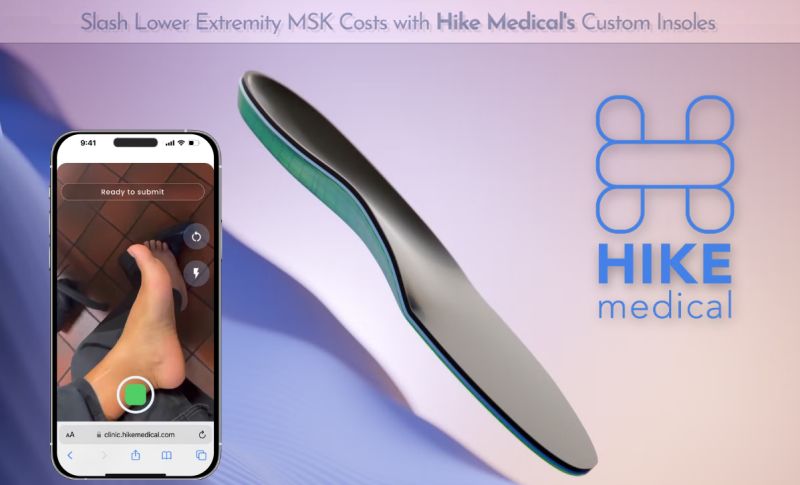
Instead of relying on foam impression boxes or dedicated scanning hardware, its clinical workflow allows body geometry to be captured using a mobile device. The scan, clinical documentation and order are connected digitally to Hike’s central manufacturing operation.
The company manufactures custom devices at its SoleForge facility in Peoria, which it describes as the largest orthotic 3D-printing farm in the United States.
According to the company’s funding announcement, this approach reduced turnaround from weeks to days. Hike also reports that its remake rate decreased from approximately one in 15 devices to one in 400.
These are company-reported figures, but they highlight two important performance measures for any digital O&P workflow: how quickly the patient receives the product and how frequently the device must be remade.
Building One System from Referral to Delivery
Hike’s wider strategy is to connect administration, clinical assessment and manufacturing rather than treating them as separate products.
Its platform has three principal elements:
- Hike Intelligence uses AI agents to process referrals, verify insurance requirements, obtain documentation and support payment approval.
- Hike Clinical provides clinicians with a connected system for assessment, scanning, documentation and ordering.
- Hike Lab manufactures custom products in-house using additive manufacturing, with a stated turnaround of around five business days.
The company is therefore not presenting itself simply as an insole laboratory or software supplier. Its ambition is to control the pathway from receipt of a referral to delivery of a completed device.
It plans to extend the platform into the broader US durable medical equipment market, which includes prosthetic limbs, braces, wheelchairs, cranial remoulding orthoses, diabetic footwear and other products supporting mobility and independence.
What the Model Could Mean for IMEA
The administrative problems faced by US providers are heavily influenced by Medicare, private insurance and American documentation requirements. Hike’s current platform cannot simply be transferred unchanged to the IMEA region.
However, the broader problems it addresses are familiar across many countries:
- Referrals arriving through disconnected systems
- Incomplete clinical or funding documentation
- Repeated data entry
- Long manufacturing lead times
- Limited access to specialist scanning equipment
- Patients travelling several times for one device
- Poor visibility of an order’s progress
- Remakes caused by inaccurate capture or lost information
- Weak connections between clinics and central fabrication facilities
The ability to use an ordinary mobile device for scanning could be particularly relevant in geographically dispersed markets. A trained clinician or technician could potentially capture information in a regional clinic while a central laboratory completes design and manufacture.
This model could support remote areas of East and West Africa, island states, conflict-affected health systems and large countries where advanced manufacturing is concentrated in one or two cities.
Technology Must Strengthen Clinical Practice
The Hike story should not be interpreted as evidence that artificial intelligence or 3D printing can replace the prosthetist, orthotist or podiatrist.
A scan records geometry. It does not independently determine diagnosis, tissue tolerance, correction strategy, pressure relief, material requirements or whether an orthosis is clinically appropriate.
Successful digital provision still requires trained professionals to:
- Conduct the clinical assessment
- Select the correct device and design objectives
- Identify risk factors and contraindications
- Validate scan quality
- Review the manufactured product
- Fit and adjust the device
- Educate the user
- Measure outcomes and arrange follow-up
The value of automation is in removing avoidable administrative work and improving production consistency, allowing clinicians to spend more time on patient care.
Lessons for Regional O&P Businesses
Hike’s vertical-integration model offers several lessons for rehabilitation businesses across IMEA.
First, digitising only the manufacturing stage may produce limited gains if referrals, documentation and ordering remain manual. The greatest improvements may come from connecting the entire pathway.
Second, turnaround and remake rates should be measured. Digital technology should be evaluated by its effect on delivery time, fit, clinical outcomes and total cost—not by the novelty of the scanner or printer.
Third, central manufacturing can expand access only when it is supported by local clinical capacity. A regional production hub needs trained professionals at the point of assessment and fitment.
Finally, software must be adapted to local systems. A platform developed for US reimbursement would require significant localisation for national health services, private insurers, government tenders, charitable programmes and self-pay markets across IMEA.
From Craft to Digital Scale
There is something especially significant about the Bhanti family’s story for the international O&P profession.
The journey did not begin in Silicon Valley. It began with a practitioner making orthoses by hand in India. The next generation built a clinical organisation around direct patient care. The third is attempting to convert that accumulated knowledge into infrastructure capable of operating at far greater scale.
That progression should be celebrated without dismissing the importance of craft. Digital systems are most valuable when they preserve clinical knowledge, make high-quality work repeatable and allow more people to receive appropriate care.
Hike Medical’s funding provides the resources to test whether its approach can expand from custom insoles into the much larger device-based care sector. Whatever the eventual outcome, the investment demonstrates that O&P workflows, clinical expertise and custom manufacturing are attracting serious attention from technology investors.
For IMEA, the most relevant question is not whether Hike’s US platform will immediately enter the region. It is whether regional providers, manufacturers and health systems can apply the same principle: connect clinical knowledge, administration and production so that devices reach patients faster, more consistently and with less wasted effort.
- Original Bharat CPO article
- Hike Medical
- Hike Medical funding announcement
- Aadi Bhanti: Hike’s long-term vision
- Amit Bhanti – American Orthotic and Prosthetic Association
- Saga Ventures
- IMEA CPO