 By
By
For many certified prosthetists and orthotists across India, the Middle East and Africa, clinical reputation has traditionally been built through hospital referrals, doctor relationships, patient word-of-mouth and community trust. These remain essential. But today, patients and families often begin their search online before they ever visit a clinic, hospital or rehabilitation centre.
A parent looking for a paediatric AFO, an amputee searching for a prosthetic leg, a diabetic patient needing protective footwear, or a family member comparing rehabilitation options will often turn first to Google, social media or WhatsApp.
This means every O&P clinic now needs a basic online presence that is clear, credible and easy to act on. Online marketing does not need to be complicated or expensive. The most important goal is simple: help the right people find your clinic, understand what you offer and contact you with confidence.
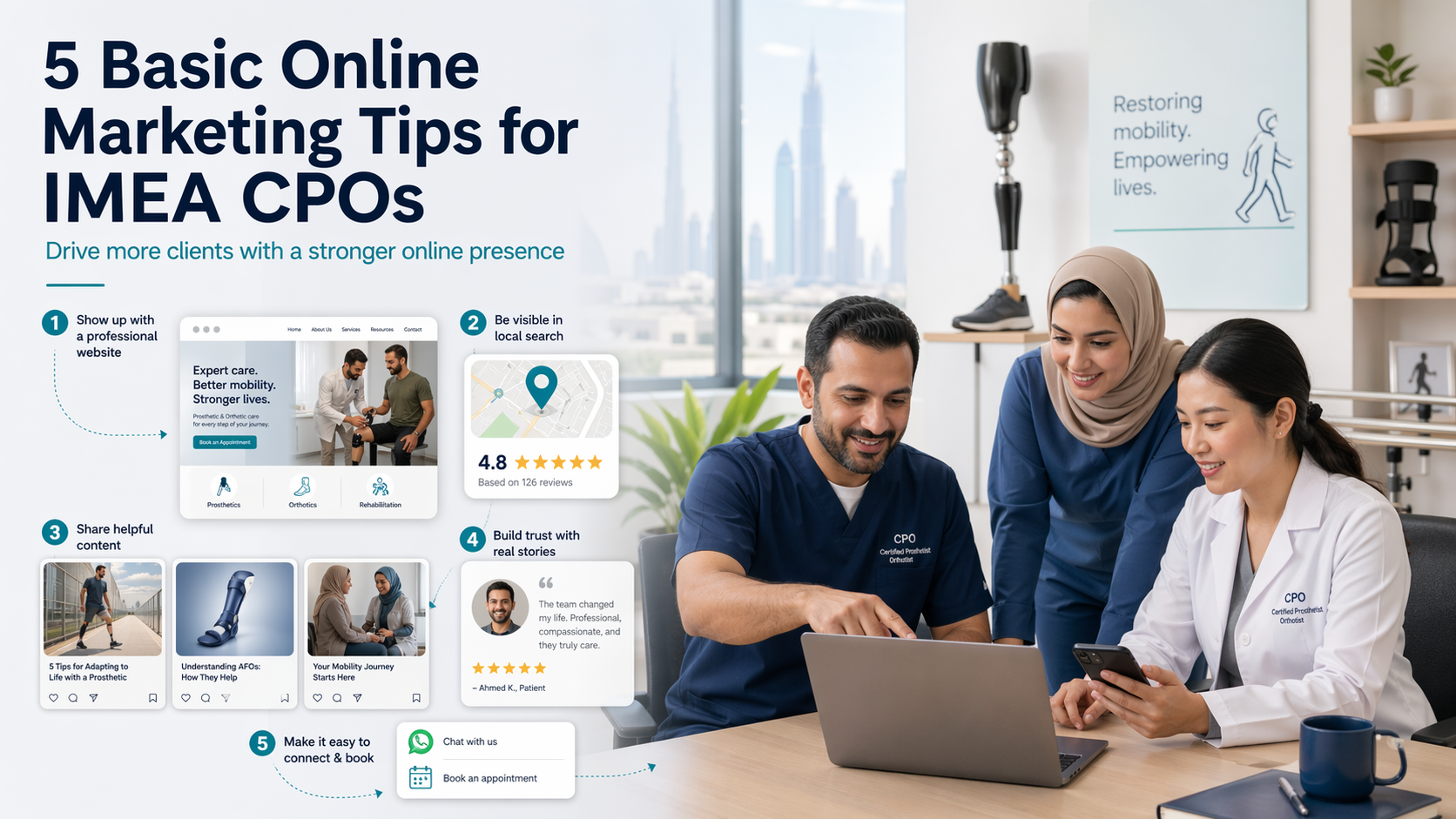
Here are five practical online marketing tips for CPOs and O&P clinics across the IMEA region.
1. Make Your Website Clear, Local and Patient-Friendly
Your website does not need to be large, but it must clearly explain who you help, what services you provide and how patients can contact you.
Many O&P websites are written like supplier catalogues or technical brochures. That may be useful for clinicians, but patients and families usually need simpler language. They want to know whether you can help with their specific problem.
A strong O&P clinic website should include clear pages for:
- Prosthetic limbs
- Orthotic braces
- Paediatric orthotics
- Spinal braces
- Diabetic foot care and footwear
- Stroke and neurological rehabilitation support
- Silicone liners and socket comfort
- Repairs, adjustments and follow-up care
Each page should answer basic patient questions: Who is this service for? What happens during the appointment? How long does fitting usually take? What should the patient bring? Is follow-up included?
Local search is also important. A clinic in Dubai, Nairobi, Mumbai, Riyadh, Lagos, Amman or Accra should mention its city and service area clearly. Patients often search for phrases such as “prosthetic leg clinic in Dubai” or “AFO brace near me”. If your website does not include those words, it may not appear when they search.
A good website should also make contact easy. Include a visible phone number, WhatsApp button, clinic address, opening hours and appointment form.
2. Use Google Business Profile Properly
For many O&P clinics, a Google Business Profile may be more important than the website itself. When someone searches for a prosthetics clinic, orthotics clinic or rehabilitation service nearby, Google often shows local business listings first.
A complete Google Business Profile helps patients find your clinic on Google Search and Google Maps. It should include:
- Correct clinic name
- Accurate address
- Phone number
- Website link
- WhatsApp or appointment link if available
- Opening hours
- Clinic photos
- Service categories
- Patient-friendly service descriptions
Photos matter. Patients and families want to know what the clinic looks like before they visit. Add images of the reception area, consultation rooms, workshop, gait training area and exterior entrance. Keep the images professional and respectful. Avoid showing identifiable patients unless you have proper written consent.
Reviews also matter. Encourage satisfied patients to leave honest Google reviews. Do not pressure them and do not offer incentives. A steady flow of genuine reviews builds trust, especially for patients making a major decision about prosthetic or orthotic care.
Respond politely to reviews, including negative ones. A calm and professional response can show future patients that your clinic takes feedback seriously.
3. Post Educational Content, Not Just Product Photos
Many O&P clinics post only product images: feet, knees, braces, liners, shoes or workshop photos. These can be useful, but they often do not explain why a patient should choose your clinic.
Educational content is usually more effective. It helps patients understand their condition, recognise when they need help and trust your clinical expertise.
Useful content ideas include:
- “When does a child need an AFO?”
- “How often should a prosthetic socket be reviewed?”
- “Signs that your prosthetic socket no longer fits properly”
- “What is the difference between a below-knee and above-knee prosthesis?”
- “How diabetic patients can protect their feet”
- “What to expect at your first orthotics appointment”
- “Why follow-up is important after receiving a brace”
- “How to care for silicone liners in a hot climate”
This content can be shared as short articles, LinkedIn posts, Instagram carousels, Facebook posts, short videos or WhatsApp updates.
The best online content is not about showing how advanced the clinic is. It is about answering the questions patients are already asking. When people feel educated, they are more likely to make contact.
4. Build Trust with Real Stories and Professional Proof
O&P care is personal. Patients are not only buying a device; they are trusting a clinician with mobility, comfort, confidence and quality of life.
Your online presence should show that your clinic is professional, ethical and experienced.
Trust-building content can include:
- Clinician profiles
- Qualifications and certifications
- Clinic history
- Workshop capability
- Before-and-after examples, with consent
- Patient testimonials, with consent
- Case studies, with privacy protection
- Hospital or rehabilitation partnerships
- Training and continuing education updates
- Community outreach activities
For CPOs, a strong personal profile can be powerful. Patients and referral partners want to know who will assess them. A short profile should include your qualification, years of experience, areas of interest and patient care philosophy.
For example, a clinician might say: “I specialise in lower-limb prosthetic fitting, socket comfort and gait training for adults returning to work after amputation.”
That is more meaningful than a generic title alone.
Ethics are important. Never use patient images, names or stories without permission. Be especially careful with children, trauma cases and humanitarian settings. Dignity should always come before marketing.
5. Make It Easy for Doctors, Therapists and Patients to Refer
Online marketing is not only for patients. It is also for doctors, physiotherapists, occupational therapists, nurses, diabetes educators, wound care teams, NGOs and hospital administrators.
Your website and social media should make referrals simple.
Create a clear “Refer a Patient” page that includes:
- Who can refer
- What information is needed
- Which conditions you support
- Contact details for referrals
- WhatsApp or email option
- Clinic location
- Expected response time
- Whether urgent cases can be accommodated
You can also create simple downloadable referral forms for prosthetics, orthotics, diabetic footwear and paediatric orthotics.
This is especially useful in the IMEA region, where many referrals happen informally through WhatsApp, phone calls or personal networks. A clear online referral pathway makes your clinic easier to work with and more professional in the eyes of referral partners.
Clinics should also consider building separate information pages for common referral sources, such as:
- Orthopaedic surgeons
- Vascular surgeons
- Diabetologists
- Rehabilitation physicians
- Physiotherapists
- NGOs and humanitarian organisations
- Insurance companies
- Government disability services
Each group has different priorities. A surgeon may want fast post-operative prosthetic planning. A physiotherapist may want gait training collaboration. An NGO may need scalable and affordable device options. Clear messaging helps each partner understand how your clinic can support them.
Why Online Marketing Matters for O&P Clinics
Online marketing is not about making healthcare commercial or superficial. At its best, it helps people find the right care sooner.
A patient with a painful socket should know where to go for adjustment. A parent should understand that early orthotic care can help a child’s mobility. A diabetic patient should learn that protective footwear may reduce the risk of serious complications. A doctor should know which clinic can provide reliable prosthetic and orthotic support.
For CPOs across the IMEA region, a strong online presence can support:
- More patient enquiries
- Better referral relationships
- Stronger clinic credibility
- Improved patient education
- Higher trust before the first visit
- Better visibility in local search
- More consistent follow-up and communication
The clinics that succeed online are not always the biggest or most expensive. They are usually the clearest, most helpful and most consistent.
IMEA CPO Perspective
The O&P profession across India, the Middle East and Africa is changing. Patients are more informed. Families compare options. Doctors search online for service partners. NGOs and procurement teams review digital credibility before making contact.
This creates an opportunity for CPOs to use online marketing not only to grow their clinics, but to raise awareness of prosthetics, orthotics and rehabilitation as essential healthcare services.
The key is to keep the message practical, ethical and patient-centred.
Start with the basics: a clear website, a complete Google Business Profile, helpful educational content, professional trust signals and an easy referral pathway. These five steps can make a major difference in how patients and partners find, understand and choose an O&P clinic.
For many clinics, the next client may already be searching. The question is whether they can find you, trust you and contact you easily.