 By
By
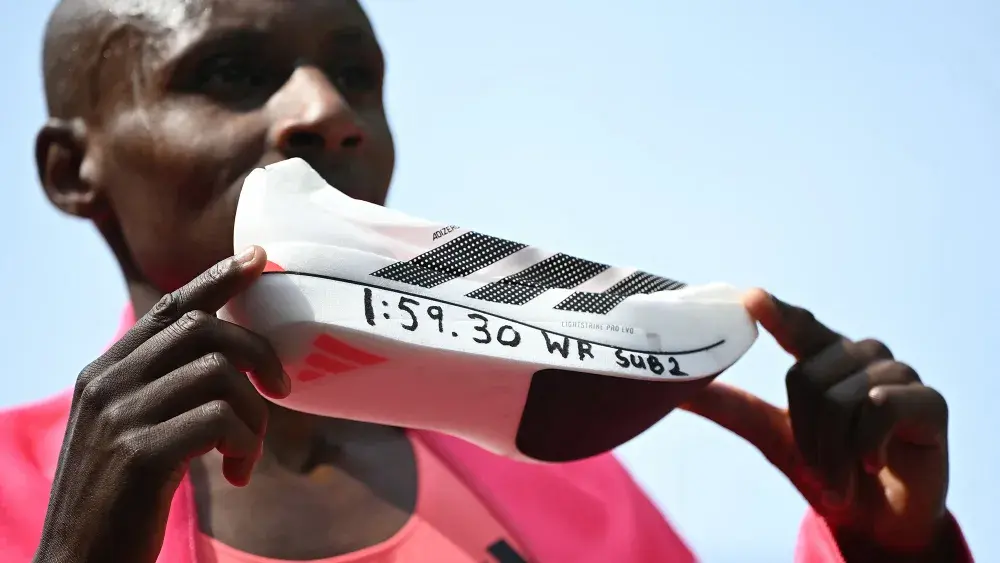
Adidas’ latest marathon racing shoe, the Adizero Adios Pro Evo 3, has drawn global attention after elite athletes wearing the shoe delivered record-setting performances at the 2026 London Marathon. According to WWD, the shoe was worn by top Adidas athletes during a historic race weekend, bringing renewed focus to the role of advanced footwear technology in elite running.
For CPOs, orthotists, prosthetists, podiatrists and foot specialists, the wider story is not simply about marathon records. The more important question is what this level of materials engineering tells us about the future of clinical footwear, orthoses, offloading, gait support and patient-specific performance.
The Adidas Adizero Adios Pro Evo 3 is described by Adidas as its lightest and fastest racing shoe to date, weighing an average of 97 grams in sample UK 8.5 sizing. Adidas says the model is 30% lighter than its predecessor, delivers 11% greater forefoot energy return, and improves running economy by 1.6% compared with the previous version.
The key material innovation is Adidas’ next-generation Lightstrike Pro Evo foam, which the company describes as its lightest and most responsive foam to date. Adidas says the foam is nearly 50% lighter than previous iterations while maintaining the cushioning, propulsion and energy-return properties required for elite marathon racing.
For clinicians, this matters because foam technology is central to many O&P decisions. In orthotic footwear and foot orthoses, materials must balance shock absorption, deformation control, rebound, durability, weight and patient comfort. While an elite racing foam is not the same as a diabetic insole, an AFO interface, or an everyday orthotic topcover, the design principle is highly relevant: lighter materials that manage load more efficiently can improve comfort, reduce fatigue and support better movement.
The Evo 3 also introduces Adidas’ ENERGYRIM, a carbon-integrated propulsion system that replaces the brand’s earlier EnergyRod approach. Adidas describes ENERGYRIM as a carbon design intended to change how stiffness and propulsion are delivered in a super shoe. Independent running analysis from RoadTrailRun notes that the system uses a continuous carbon rim around the rearfoot, becoming two outer carbon blades in the forefoot, rather than a traditional full plate or rod structure.
This design is particularly interesting for CPOs because it shows how stiffness does not need to be uniform across the whole foot. By controlling where stiffness is placed, footwear and orthotic systems can influence rollover, forefoot loading, toe-off, pronation control and energy transfer. In clinical practice, similar thinking appears in carbon foot plates, rocker soles, AFO struts, partial-foot prostheses, diabetic offloading footwear and custom orthoses designed to redistribute plantar pressure.
The shoe’s geometry also matters. Adidas lists the Evo 3 with a 39 mm heel stack, 36 mm forefoot stack and 3 mm drop. This high-stack, low-drop geometry is designed to provide cushioning and forward propulsion while staying within elite racing regulations.
For patients, geometry can be just as important as materials. Rocker profiles, heel-to-toe drop, forefoot stiffness, sole thickness and midsole compliance can all affect gait mechanics. A patient with metatarsalgia, hallux limitus, forefoot overload, plantar fasciopathy, ankle weakness or partial-foot amputation may benefit from footwear or orthotic designs that reduce painful loading and improve rollover. The Adidas example highlights how much function can be engineered into the shoe platform itself.
Adidas also uses strategically placed Continental rubber in the forefoot to improve traction without adding unnecessary weight. This is a small but clinically relevant detail. In O&P and therapeutic footwear, outsole selection can influence safety, confidence, slip risk, durability and patient compliance. Lightweight traction materials are particularly valuable for older patients, neurological patients, diabetic users, amputees, and anyone who may reject heavy or bulky footwear.
The upper is another important part of the technology story. Reports on the Evo 3 describe a highly minimal upper using lightweight, high-strength textile concepts inspired by performance applications such as sailing and kite-surfing. Vogue reported that the upper uses high-strength, lightweight ripstop textiles, helping the shoe reach its sub-100 gram target.
For CPO patients, upper design is often underestimated. Footwear uppers can affect edema accommodation, pressure points, donning, skin safety, breathability, stability and brace compatibility. A high-performance racing upper is built for speed, not necessarily therapeutic protection, but the material direction is still relevant: strong, light, low-bulk textiles can help make supportive footwear less heavy and more acceptable to patients.
The clinical message is not that patients should be placed into elite carbon-plated racing shoes. In fact, many patients may be unsuitable for this type of footwear. The Evo 3 is extremely narrow, expensive and designed for highly trained runners, not for broad clinical use. RunRepeat’s early review specifically notes that it is not ideal for heel strikers and has a narrow, restrictive fit.
The real lesson for CPOs is that footwear is becoming a functional medical-technology platform. Carbon structures, responsive foams, targeted stiffness zones, low-mass uppers, rocker geometry and traction materials can all influence gait, comfort and loading. These same principles can inform how clinicians think about custom insoles, AFO-footwear combinations, diabetic footwear, sports orthoses and return-to-running pathways.
How CPO Patients Could Benefit From This Technology Direction
Advanced footwear materials may benefit patients when translated into appropriate clinical products and orthotic workflows:
- Reduced fatigue: Lighter footwear and orthoses can reduce perceived effort, especially for patients who already use braces, prostheses or mobility aids.
- Improved rollover: Carbon structures and rocker geometry can help support smoother transition from heel strike to toe-off.
- Better pressure redistribution: Foams and midsole geometries can be selected to reduce painful peak pressures under the forefoot, heel or midfoot.
- Greater patient acceptance: Less bulky, lighter materials may improve compliance with orthoses and therapeutic footwear.
- Sport and activity return: Performance footwear concepts can help inform safe return-to-running pathways for selected patients.
- More precise orthotic design: Understanding stiffness zones can help clinicians choose when to use carbon plates, metatarsal rockers, forefoot extensions, heel lifts or custom insole modifications.
Practical CPO Takeaway
The Adidas Adizero Adios Pro Evo 3 is an elite racing shoe, not a therapeutic device. But its design points toward the same future that O&P is already moving toward: lighter materials, smarter stiffness, better energy management, improved pressure control and footwear that actively supports movement.
For CPOs, the opportunity is to translate these ideas into patient-appropriate solutions. That could mean pairing custom foot orthoses with suitable rocker footwear, using carbon plates for selected forefoot conditions, designing lighter AFO-footwear combinations, or educating patients on how footwear materials affect comfort and gait.
The super shoe story is therefore not only about elite marathoners. It is also a reminder that material science is changing what patients may expect from footwear, orthoses and mobility devices.