 By
By
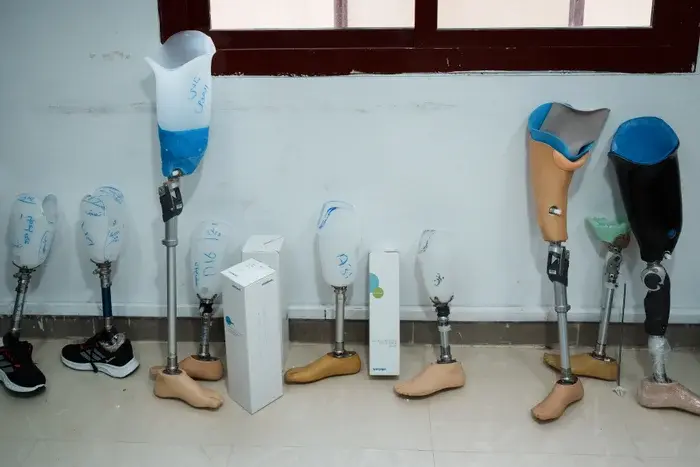
A new report in The Guardian highlights the worsening situation facing Palestinians from Gaza who lost limbs during the war and were later evacuated to Egypt for treatment, only to find themselves trapped in legal and humanitarian limbo. The article says that for many amputees, leaving Gaza was supposed to be the beginning of recovery, but in practice it has become the start of a new struggle shaped by uncertain legal status, unstable housing, interrupted rehabilitation, and limited access to long-term care.
The scale of the need is already severe. The Guardian reports that more than 6,000 adults and children in Gaza have undergone amputations since October 2023, citing the World Health Organization and the Palestinian Ministry of Health. At the peak of the war, the article says, reports suggested that around 10 children a day were losing one or both legs. That aligns with earlier public warnings from child-focused agencies about the extreme rate of limb loss among children in Gaza.
For IMEA CPO readers, the most important point is that this is not only an acute trauma story. It is also a long-term rehabilitation failure. Egypt has become the main medical exit point for many severely injured Palestinians, but The Guardian says amputees who make it across the border often find themselves stuck between emergency treatment and meaningful recovery, without the stable legal, financial, and clinical support needed to rebuild their lives.
That gap matters because amputation recovery does not end when a patient leaves the operating theatre or crosses a border. It depends on repeated assessments, prosthetic planning, wound management, therapy, psychosocial support, housing stability, and often international referral for reconstructive or specialist care. The Guardian report suggests that many Gaza amputees in Egypt are living far from that ideal, in conditions where the pathway from injury to rehabilitation remains fragmented and uncertain. This is an inference from the report’s description of “life-changing injuries” and post-evacuation limbo, but it is strongly supported by the article’s framing and by WHO’s continuing guidance on the medical evacuation process.
The wider context makes the situation even more precarious. WHO has said that severely ill or injured patients needing specialized care unavailable in Gaza may be evacuated through a process coordinated with host countries, but those pathways remain limited and fragile. Separate recent reporting notes that WHO temporarily suspended Gaza medical evacuations after a worker was killed, further exposing how vulnerable the evacuation system remains. Meanwhile, more than 18,500 patients are still reported to need urgent medical evacuation from Gaza.
For rehabilitation and O&P audiences, this exposes a familiar but often neglected problem: evacuation is not the same as continuity of care. A patient may survive the initial injury, receive emergency surgery, and leave Gaza, but still remain far from any consistent pathway to prosthetic fitting, gait training, residual limb management, or functional reintegration. In this sense, the Gaza amputees stranded in Egypt are caught between two systems: one that could not treat them fully in Gaza, and another that has not absorbed them into secure long-term rehabilitation. This is an inference, but it follows directly from the Guardian’s account and the WHO evacuation framework.
The burden on children is especially stark. Earlier Guardian reporting described Gaza as having more child amputees than anywhere else in the world, while HEAL Palestine has separately highlighted the years of prosthetic, psychological, and educational support now needed by children living with limb loss. The new Egypt-focused report suggests that even when children and families escape immediate danger, the international pathway to treatment and rehabilitation remains deeply inadequate.
For IMEA CPO readers, the story is a reminder that prosthetic need in conflict settings cannot be understood only in terms of device volume. The real challenge is systems continuity: legal status, cross-border referral, long-term rehabilitation, and access to specialists who can stay with the patient over time. When those structures fail, even patients who survive and leave the war zone can remain effectively stranded, medically and socially, for months. This is an inference, but it is the clearest implication of the Guardian report.
Why this matters
The central lesson is that Gaza’s amputation crisis does not stop at the border. For many Palestinians evacuated to Egypt, survival has been followed by legal uncertainty, interrupted care, and an incomplete rehabilitation pathway. For the O&P and rehabilitation sector, that makes this not only a humanitarian story but a systems story, one that shows how easily long-term recovery can break down when evacuation, protection, and rehabilitation are not joined up.