 By
By
When people think of agricultural technology today, they often imagine drones, artificial intelligence, automated machinery and advanced sensors. But for many smallholder farmers around the world, innovation can be far simpler—and just as transformative.
In Sierra Leone, a unique agricultural initiative is demonstrating that sometimes the most impactful form of “agri-tech” is not digital or high-tech at all. Instead, it may be something as simple as a wheelbarrow redesigned for a farmer living with limb loss.
Farming as a Path Back to Independence
For many amputees in Sierra Leone, earning a living can be extremely difficult. After the country’s civil war left thousands of people with limb loss, many survivors struggled to find employment and were often excluded from physically demanding work such as farming.
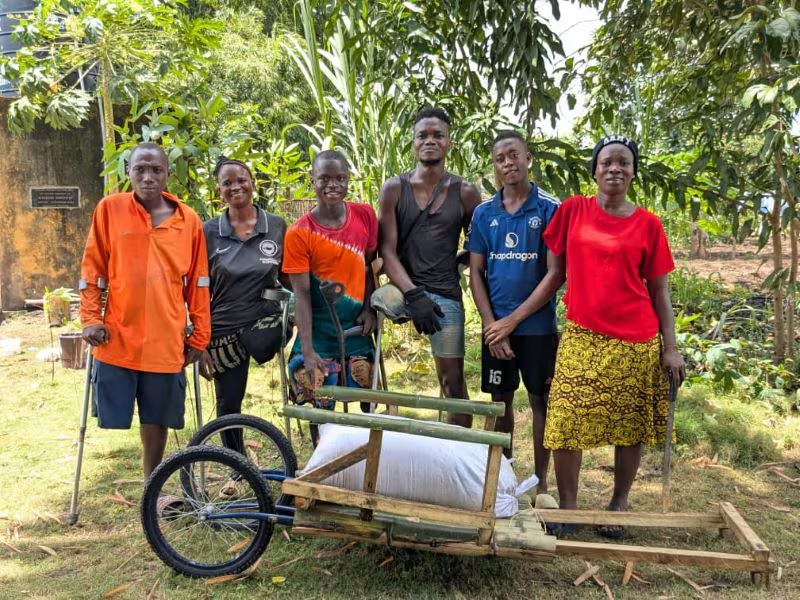
The organisation Farming on Crutches has been working to change that reality. The initiative provides amputees with training in regenerative agriculture, helping participants build skills that allow them to establish their own small farms and generate income within their communities.
Training takes place on a demonstration farm that acts as a “living classroom”, where participants learn practical techniques ranging from soil management to sustainable crop production. The goal is not only to improve livelihoods, but also to restore confidence and independence for people who have often been marginalised.
Innovation Designed by Farmers Themselves
Rather than relying on expensive imported technology, the programme focuses on practical solutions designed by the farmers themselves.
One of the most important tools for small-scale farmers is the humble wheelbarrow. But for someone who has lost a limb, using a traditional wheelbarrow can be extremely difficult.
To solve this challenge, participants worked together to develop a modified version using bamboo, locally sourced timber and bicycle wheels. The result is a stable and lightweight design that allows amputee farmers to transport crops, soil and equipment much more easily across their fields.
This simple innovation dramatically improves productivity while remaining affordable and easy to repair using locally available materials.
Designing for the Margins
A key philosophy behind the project is that people with disabilities should be involved from the very beginning of the design process. Instead of adapting equipment after it has already been developed, the programme encourages farmers with disabilities to help shape tools and techniques that work for their specific needs.
This approach has broader implications for the agricultural technology industry. When equipment is designed to work for those facing the greatest physical challenges, it often becomes more practical and efficient for everyone.
As project leaders point out, innovation should not be judged only by yield increases or technical complexity. Its true value lies in whether it improves people’s ability to work, earn an income and live independently.
A Model That Could Spread Across Africa
The training programme has already helped dozens of amputees develop farming skills and establish small agricultural enterprises. Graduates are encouraged to pass on their knowledge to others in their communities, creating a multiplier effect that spreads both economic opportunity and regenerative farming practices.
Looking ahead, the project hopes to expand its activities across Sierra Leone and potentially into neighbouring West African countries. Plans include introducing additional income-generating activities such as beekeeping and small-scale food processing to help farmers diversify their livelihoods.
Technology That Changes Lives
In an era when agriculture is often associated with sophisticated digital tools and large-scale automation, the Sierra Leone initiative is a reminder that innovation does not always need to be complex.
Sometimes, the most powerful technology is simply a tool designed with empathy and practicality—one that removes barriers and restores dignity to those who have long been excluded.
For Sierra Leone’s amputee farmers, a redesigned wheelbarrow is not just a piece of equipment. It is a symbol of independence, resilience and the power of inclusive design.