 By
By
By Lidiya Moges – Assistive Technology & Wheelchair Services Specialist, Addis Guzo
Across many low- and middle-income countries, improving access to wheelchairs and assistive devices for children is often seen as the primary challenge. However, even when referral pathways exist and equipment becomes available, another critical barrier quickly emerges — the shortage of trained professionals in pediatric seating, positioning, and wheelchair provision.
In Ethiopia, this gap is particularly evident. The rehabilitation workforce remains extremely small relative to the size of the population. For more than 120 million people, there are fewer than 800 physiotherapists and only a very limited number of occupational therapists, with no dedicated academic training programs focused on wheelchair provision or pediatric seating. Most training in assistive technology is delivered through non-governmental organisations, and even then, clinicians may not receive specialised education in postural management and seating systems.
As a result, children who are referred for mobility support may still not receive appropriate care, simply because the clinical expertise required to assess, prescribe, and adjust seating systems is not available.
In many low-resource settings, the number of professionals trained in pediatric positioning and wheelchair provision is extremely limited, and in some regions almost non-existent. This creates a serious risk, because a seating system is not just equipment — it is a clinical intervention that must be carefully assessed and monitored.
Proper seating provision requires evaluation of multiple factors, including postural alignment, muscle tone and control, growth and development, risk of deformity, and the functional goals of the child. Without trained professionals guiding this process, the results can be harmful rather than helpful.
Poorly fitted wheelchairs or seating systems may lead to incorrect positioning supports, lack of adjustment as the child grows, and absence of follow-up care. Instead of preventing complications, inadequate provision can contribute to contractures, hip displacement, spinal deformities, and reduced participation in daily life. In this context, simply providing a wheelchair cannot be considered a complete solution.
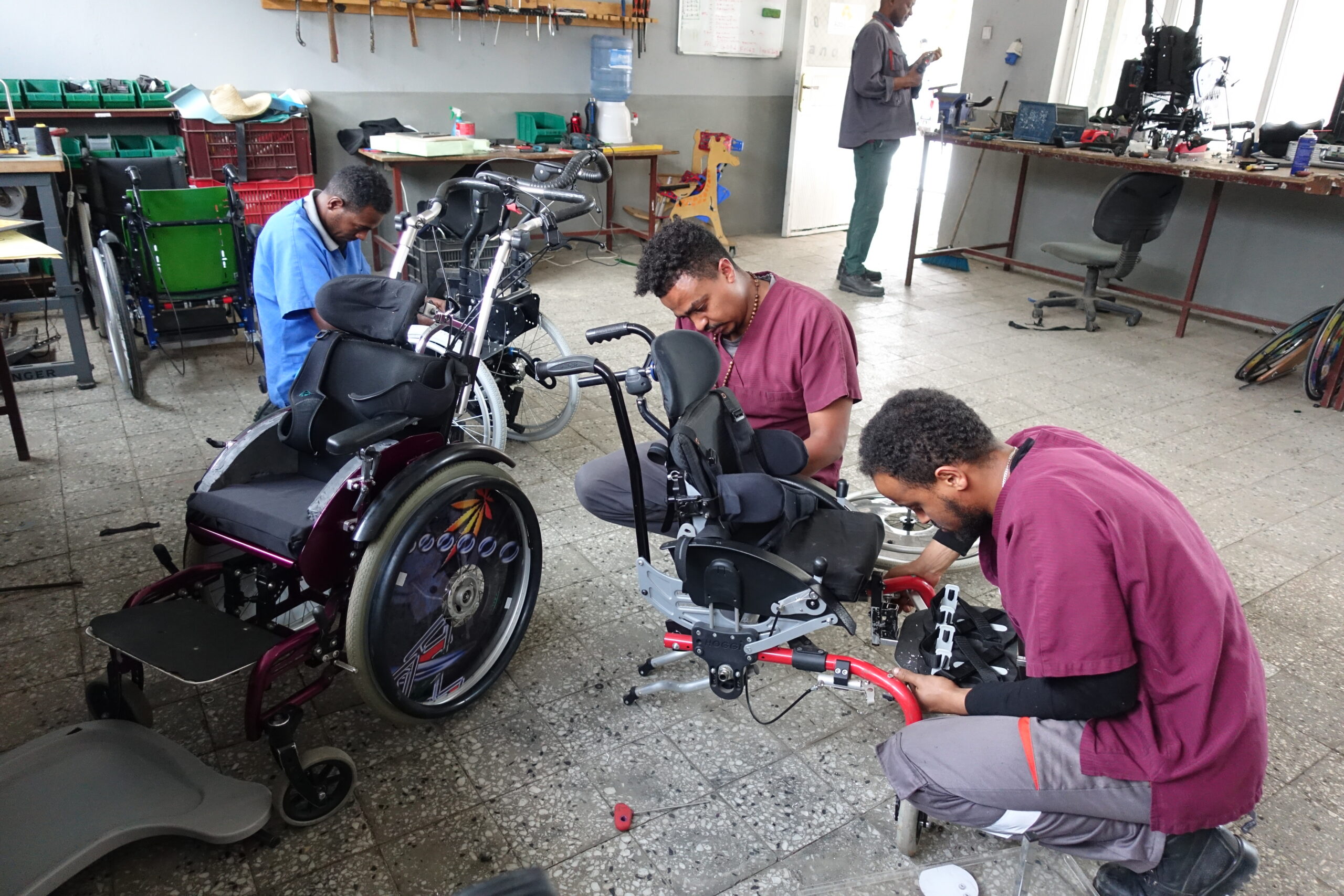
Addressing this problem requires investment not only in equipment, but in clinical capacity. The most urgent need is for specialised training in wheelchair service delivery and pediatric seating.
One important step is integrating the World Health Organization Wheelchair Service Training Package (WSTP) into physiotherapy and occupational therapy curricula, ensuring that future rehabilitation professionals graduate with the necessary skills. Establishing national training centres dedicated to wheelchair provision and postural management would also help build sustainable expertise. Training-of-trainers programs can further expand capacity by enabling local specialists to educate others, while advanced courses in pediatric seating should be made available for clinicians already working in the field.
The ultimate goal is not simply to provide a wheelchair. The goal is to support the child’s posture, development, health, and participation throughout childhood. Without skilled professionals, even the best equipment cannot achieve that outcome. With proper training and investment, however, wheelchair services can become a powerful tool for inclusion, independence, and long-term quality of life.